
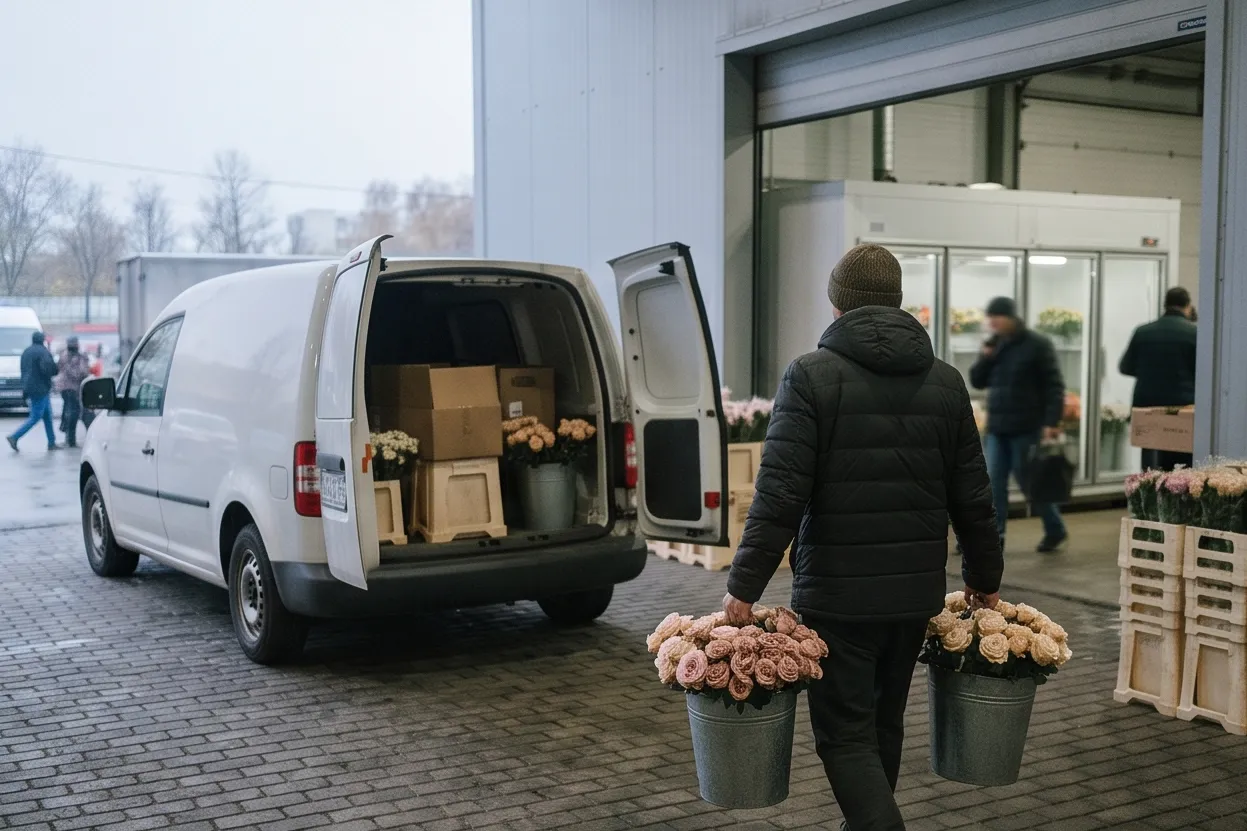
Wholesale flowers for a small shop usually come from two or three places: a cash-and-carry wholesaler or the flower truck that stops at your door each week, pre-orders from a Dutch exporter or an online wholesale platform, and local growers in season. The cheapest line on a price list rarely decides what is cheapest for you. What decides it is the cost of a stem you actually sold, after stem length, freshness, delivery and waste.
In short
- For most shops the backbone is a cash-and-carry or a flower truck: you buy by the bunch, see the goods and take them away the same day.
- Pre-orders from an exporter, the auction or the farm are cheaper per stem, but need planning a week or two ahead, larger quantities and often prepayment.
- Compare like with like on a price list: price per stem or per bunch, stem length, origin, variety and delivery date.
- Buy for 3–4 days of sales, and book Valentine's Day and Mother's Day stock in advance at a fixed price.
- A cheap batch with a third in the bin costs more than a normal one: count the cost of stems sold, not stems bought.
Where to buy wholesale flowers: six channels
A shop has six ways to buy, and they differ in more than price. They differ in who carries the risk when a batch arrives damaged: you or the supplier. The overview below is a rough guide for autumn 2026. Lead times and quantities are indicative and every supplier sets its own terms.
| Channel | How you buy | Quantity | Delivery | Strengths | Weak points |
|---|---|---|---|---|---|
| Cash-and-carry wholesaler | In person, by phone or on the wholesaler's website | From one bunch, often a minimum order sum for delivery | Same day or next day | You see the goods, damage is swapped on the spot | Higher price per stem than pre-order |
| Flower truck | The truck parks outside your shop on a fixed day each week | From one bunch | Weekly or twice a week | Wide choice at your door, no trip to the market | Limited to what is on board that day |
| Exporter or online wholesale platform | Order from a list or webshop for a set shipment day | Bunches or boxes, sometimes per trolley layer | Next day to several days, by truck | Huge range straight from the Dutch trade | Cannot inspect before delivery, cut-off times are strict |
| Auction clock through a buying agent | The agent buys at Royal FloraHolland from your list | Auction lots, plus the agent's commission | A few days, in a mixed load | Hundreds of varieties, rare items | Commission, no inspection, you share the risk of a bad lot |
| Direct from farms | Contract with a farm in Kenya, Ecuador or elsewhere, or via an importer | Boxes, several at a time | Days to two weeks | Best price per stem at volume | Prepayment, border checks, phytosanitary certificates, damage at your risk |
| Local growers | Direct or through your wholesaler | Bunch, crate or a few bunches | 1–2 days | Very fresh, short journey | Narrow range, seasonal |
For a shop with one or two outlets the working pattern is almost always the same: a cash-and-carry or truck as the base, pre-orders for whatever sells steadily, and local growers in season. Buying on the clock yourself needs buyer registration, access to the auction and your own transport, so florists normally reach the auction through an exporter or agent. How supply from each origin works, and why an Ecuadorian rose spends longer on the road than a Kenyan one, is explained in flowers from Holland, Ecuador and Kenya.
The cash-and-carry and the flower truck: the backbone for a shop
Ask a florist where they buy wholesale flowers and the answer is usually a cash-and-carry in their region or the truck that comes every Tuesday. Both work as your external cold room: they hold stock, take in boxes from exporters and growers, sort out damaged goods and sell by the bunch. You pay for that in their margin, and in return you can buy what you will sell in 3–4 days instead of a box that has to last a week.
What to look at when you choose:
- Opening hours and delivery. Many cash-and-carries open early so shops can buy before they open. If you want delivery, ask the cut-off time for same-day orders, what delivery costs and whether it is free above a certain order sum. For a truck, ask the route day and what happens on public holidays.
- How you see stock. Calling a sales rep every morning works, but it is slow. It is easier when the wholesaler has a website or an app that shows the goods, the price and the stock in bunches right now.
- Damage claims. How many hours after delivery they accept a claim, whether they need photos, and whether they credit or replace.
- Trade only or also retail. Many cash-and-carries sell only to registered businesses and ask for proof such as a VAT number. Those that also serve the public often have one price for walk-in buyers and another for regular trade customers on an account. Find out before your first order.
Keep at least two sources: a main one and a back-up for the day the main one is out of stock or a delivery is late. How to vet a new supplier and what to agree in advance is covered in a separate guide, linked in the section on overpaying below.
How to read a wholesale price list
A wholesale flower price list is a table with hundreds of lines, and comparing two of them by eye is close to useless. One quotes per stem, another per bunch, a third puts stem length in a separate column. Before comparing, bring every line to the same unit.
Bunch size and price per stem
Cut flowers are sold by the bunch, but bunch sizes differ. Ecuadorian roses usually come in bunches of 25 stems, Kenyan and Dutch roses in 10 or 20, and other crops have their own standards, shown on the list or the product card. If one supplier quotes €22.50 a bunch and another €0.95 a stem, divide and compare. In this illustration that is €0.90 against €0.95, provided the bunch holds 25 stems and not 20.
Stem length
Length in centimetres is the main price multiplier for roses and many other crops: the same rose costs noticeably more at 70 cm than at 50 cm. Buying long stems for a small arrangement means paying for something the florist will cut off and throw away. Which length suits which bouquet is covered in wholesale roses.
Origin and variety
Origin hints at head size, stem thickness and how long the flowers travelled: the longer the route, the more it matters how they were shipped and stored. Variety decides how the head opens and what the customer will pay. Two red stems of the same length from different countries are different products and cannot be compared on price alone.
In stock, in transit, price on request
A good list shows what is in the warehouse now and what is in transit, arriving on a given day. Goods in transit are usually cheaper and can be reserved. Items marked "price on request" are those whose price changes daily, often auction goods. Call and ask: an out-of-date figure is worse than no figure.
Minimum order, delivery and your own price
Wholesalers set a minimum in one of two ways: by order value or by quantity, such as at least one bunch or one box per item. A small shop does better with a minimum order sum and single bunches, because you can build a varied display from ten items instead of two boxes of one variety.
Trade prices are not one price either. The price on the website or the open list is for guests. A regular customer on an account usually gets their own price: a volume discount, payment terms or a fixed price on fast sellers. Ask what monthly volume opens a contract price. The threshold is often lower than you think.
It helps when your own price is visible in the catalogue instead of living in a conversation with the sales rep. On wholesaler websites built on Petala, a guest sees the open price, a trade customer who has logged in sees their contract price, and the cart counts with it. The cart also applies the minimum order sum, and stock from the warehouse is reserved for 30 minutes while you check out. You can see how this looks from the buyer's side on the demo wholesaler website.
Pre-ordering for Valentine's Day, Mother's Day and other peaks
Before Valentine's Day and Mother's Day, wholesale prices on the fast sellers rise sharply, and the most popular varieties are gone by the last week. Mother's Day falls in March in the UK and Ireland and in May in much of continental Europe, so check your own market's date. In France, Belgium and several other countries All Saints' Day on 1 November is a peak for chrysanthemums and potted plants. Many exporters and wholesalers start collecting pre-orders weeks ahead.
How to prepare a pre-order:
- Pull last year's sales for each day of the peak week: what sold, how much, and what ran out early.
- Split the list in two: what sells for certain (red and white roses for Valentine's Day, tulips and spring flowers for Mother's Day) and what you are trying out.
- Book the certain part for a specific shipment at a fixed price. Ask what happens if the shipment is late and until when you can change quantities.
- Leave the trial part for the cash-and-carry or the truck during the peak week: more expensive, but no risk of being left with unsold stock.
The catch is that a pre-order is almost always non-returnable: order a thousand tulips, pay for a thousand. Build the forecast on your own figures, not on general excitement. On some wholesalers' websites goods in transit carry their arrival date and can be reserved in advance, and the cart splits the order into shipments, from stock and from an incoming delivery, each with its own date. A full plan for buying, staffing and display around the biggest peak is in our guide for a Valentine's Day flower shop.
How not to overpay on wholesale flowers: length, delivery and volume
Everyone wants cheap wholesale flowers, but the lowest line on the list is rarely the best buy. A cheap batch is often older or travelled badly, and more of it ends up in the bin. How to compare two suppliers on the cost of a stem sold is worked through in flower suppliers. Here are three overpayments hidden inside the order itself.
Say a shop buys 100 roses a week for small bouquets and gift boxes, where stems are cut to 35–40 cm anyway. The prices are illustrative figures for the sum, not quotes.
| What we compare | Option 1 | Option 2 |
|---|---|---|
| Stem length | 70 cm | 50 cm |
| Price per stem | €0.90 | €0.65 |
| 100 stems | €90 | €65 |
| Delivery | €15 for a separate drop | Free inside a combined order above the minimum |
| Weekly total | €105 | €65 |
The difference is €40 a week, about €170 a month, and the customer will never see it: in a small bouquet 70 cm and 50 cm look the same, and the extra centimetres go in the bin. Long stems belong where they are visible, in tall bouquets and in vases on display.
Rules that save more than hunting for the cheapest wholesaler:
- Buy the length the bouquet needs. Short stems for arrangements, long stems only for what is sold long.
- Add delivery to the stem price. A €15 delivery on a €150 order adds 10% to your purchase. One order for 3–4 days beats three small ones.
- Do not take a full box for the discount. A volume discount does not pay off if half the box opens by Saturday.
- Check the goods with the driver present. Frost-damaged heads and grey mould are returned the same day. A week later you cannot prove anything.
How to track waste by supplier and by product is covered in flower waste, and how to build it into your prices in flower markup.
What else to buy from the same wholesaler
Besides cut flowers, a shop regularly buys wrapping, ribbon, floral foam, potted plants and, in recent years, dried flowers. Buying them all from one wholesaler is convenient: one delivery, one invoice, and it is easier to reach the minimum order sum. Still, compare sundries separately, because specialist packaging suppliers are sometimes cheaper.
Potted plants and dried flowers behave differently from cut flowers. They last weeks or months, so you can buy them less often and in larger lots. What matters here is less freshness and more how the plant survived the journey and whether the pot has dried out. Potted plants moving within the EU travel with a plant passport, usually printed on the supplier's label, so keep your invoices together with that information.
To avoid keeping the whole range in your head, repeat your standard order. In the buyer account on wholesaler websites built on Petala you see your order history, and a past order can be repeated in one click, with quantities adjusted.
Frequently asked questions
Where can I buy wholesale flowers for my shop?
From a cash-and-carry wholesaler in your region or a flower truck that visits shops on a fixed day: that is the main channel for a small shop. Steady sellers are cheaper as pre-orders from an exporter or online wholesale platform for a shipment date, and local growers are worth using in season. Buying direct from farms makes sense once you take several boxes every week.
Can I buy at the Dutch flower auction myself?
Buying directly on the Royal FloraHolland clock requires registration as a buyer, access to the auction and your own logistics, which rarely pays for a single shop. Most florists buy auction flowers through an exporter, a wholesaler or a buying agent who adds a commission.
What is the minimum order at a flower wholesaler?
Some set a minimum order value, others a minimum of one bunch or one box per item. The threshold for delivery is usually higher than for collection. Terms change, so ask before your first order.
Do flower wholesalers sell to the public?
Many cash-and-carries are trade only and ask for proof of a registered business. Those that also sell to the public usually charge walk-in buyers more than regular trade customers. If you buy every week, ask for an account with your own price, a volume discount or payment terms.
How do I order wholesale flowers with delivery?
Call the sales rep or order on the wholesaler's website if it has one. Ask the cut-off time for same-day or next-day orders, the delivery cost and the order sum above which delivery is free. Open the boxes while the driver is there and check the heads straight away.
 PurchasingFlower Suppliers: How to Choose and Vet Them for Your Shop
 PurchasingWholesale Roses: How to Choose Origin, Stem Length and Variety
 PurchasingFlowers from Holland, Ecuador and Kenya: where your stems really grow