
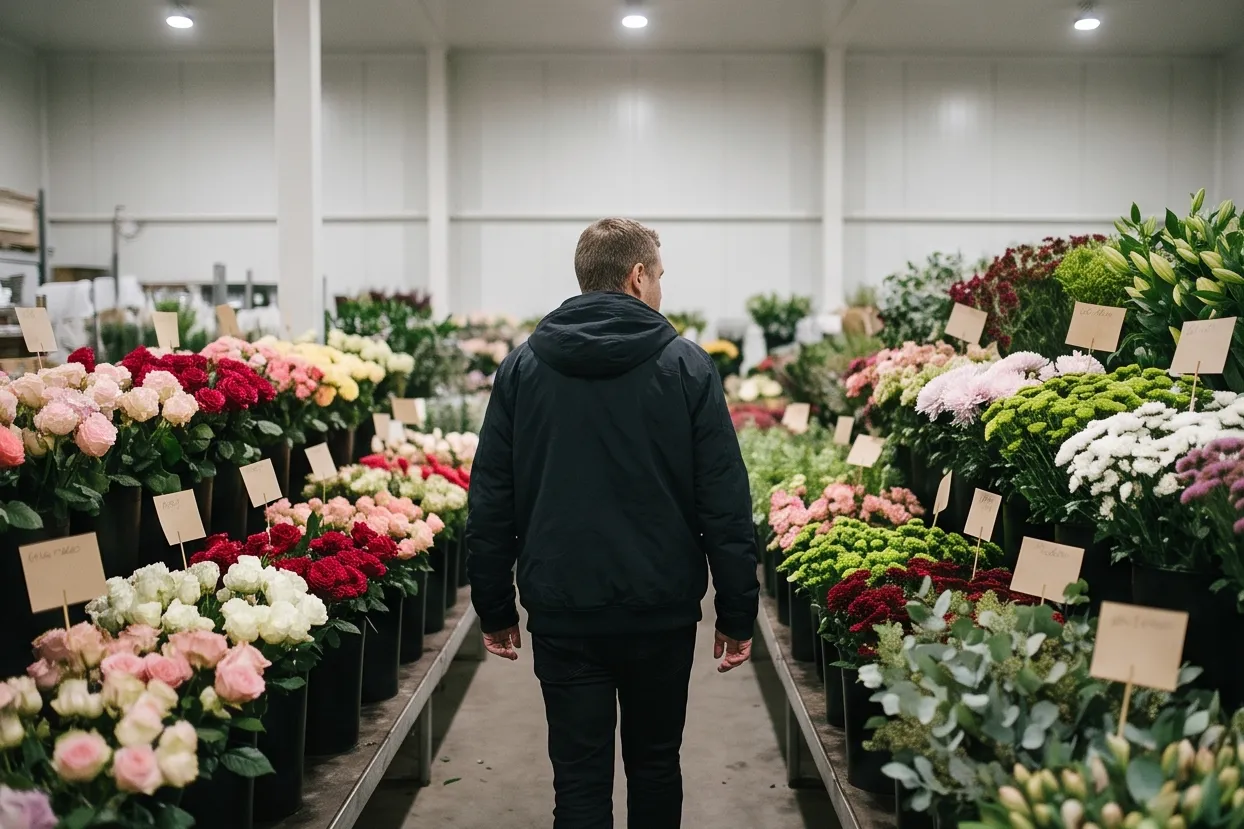
Flower suppliers for a florist come in a handful of types: a cash-and-carry wholesaler in your region, a flower truck on a weekly route, a Dutch exporter or online wholesale platform, an importer buying direct from farms, local growers and group buying with other shops. A small shop usually needs two or three of them, and the right choice is not the lowest price on the list but the one whose flowers survive until they are sold.
In short
- The list price is half the picture: a rose that is ten cents cheaper but arrives with frost-damaged heads costs more, because it ends up as waste.
- Keep one main supplier and one or two back-ups. A single source is a risk of an empty shop the week before Valentine's Day.
- Test a new supplier with a trial order and check it with the driver present: temperature in the van, water in the stems, damage by item.
- Put the terms in writing: delivery days and times, minimum order, damage claims, payment terms.
- A supplier whose stock, prices and incoming shipments are visible online saves you a round of phone calls every morning.
Types of flower suppliers
Almost every cut flower a florist sells passes through several hands: the farm, the exporter or the auction, the wholesaler, sometimes a small reseller. The closer you buy to the start of the chain, the lower the price per stem and the higher the demands on your volume, cash and experience.
| Supplier | What you get | What it asks of you | Who it suits |
|---|---|---|---|
| Cash-and-carry wholesaler | Wide range, buying by the bunch, you see the goods | Higher price than further up the chain; fast sellers go quickly before peaks | Shops, kiosks and studios of any size |
| Flower truck | Weekly visit to your door, choice from the truck | You buy what is on board that day | Shops away from a wholesale market |
| Exporter or online wholesale platform | Huge Dutch range, ordering for a shipment day | Strict cut-off times, no inspection before delivery | Shops that plan their orders |
| Importer buying direct from farms | Lower price, fresh goods to order, choice of farm and stem length | Pre-order a week or more ahead, boxes, often prepayment | Chains and large shops |
| Local grower | Short journey, freshness, steady supply of a few crops | Narrow range, seasonal | A second supplier for fast sellers |
| Group buying | Importer prices at small volume | Shared schedule, disputes over damage, payment up front | Experienced studios and small shops |
| Small reseller | Delivers any time, any quantity | Highest margin, unclear origin | Emergencies only |
Where cut flowers in Europe come from, and how a rose from Ecuador differs from a Kenyan one, is covered in flowers from Holland, Ecuador and Kenya. This guide is about choosing who you buy from.
How to choose flower suppliers for your shop: seven criteria
Compare suppliers on the same questions, or the one who talks loudest wins. These are the criteria that decide whether you have flowers on Friday evening and how many you throw away on Tuesday.
Reliable deliveries. A supplier who delivers to schedule every week is worth more than one who is sometimes cheap and sometimes empty. Ask how often a delivery failed last season and what they did about it.
Cold chain. Cut flowers should stay at +2 to +8 °C from the farm to your display. If the warehouse is warm and the van has no cooling, the flowers lose two or three days of life with you. Check this on your first visit, not on the sales rep's word.
Damage and credits. Find out the deadline for claims, whether photos are needed, and whether you get a credit or a replacement in the next delivery. A good supplier swaps a bunch with botrytis without argument. A poor one argues.
Delivery days and times. If the goods arrive at 11 and you open at 9, you sell yesterday's flowers for two hours. Delivery days should match your rhythm of buying for 3–4 days of sales.
Minimum order. For a wholesaler it is an order sum for delivery, for an importer a number of boxes. The threshold should be reachable on an ordinary weekday as well as before a peak.
Payment terms. Credit of a week or two is usually offered after two or three months of reliable payment. Asking on day one rarely works, but you can agree the conditions in advance.
Personal prices and transparency. Regular customers usually get their own price or a contract discount. That price should be visible before you order, not appear on the invoice as a surprise.
Flower supplier prices and what drives them
Flower prices change more often than almost any other product, so a search for supplier prices never gives one honest number. A rose's price depends on origin, stem length, head size, the exchange rate, the season and how many hands it passed through.
Compare the cost of a stem sold, not the list. Say two suppliers offer the same 60 cm rose. The figures are an illustration for the arithmetic, not market prices.
| Supplier A | Supplier B | |
|---|---|---|
| Price per stem | €0.90 | €1.00 |
| Stems bought | 400 | 400 |
| Purchase total | €360 | €400 |
| Waste | 20%, 80 stems | 8%, 32 stems |
| Stems sold | 320 | 368 |
| Purchase cost per stem sold | €1.13 | €1.09 |
Supplier A is 10% cheaper on the list, yet a sold stem from A costs more. The difference comes from the cold chain, freshness and how fairly the supplier handles damage. You can only run this comparison on your own data: which deliveries came from whom and how much of each was written off. How to keep that record is explained in our guide to flower waste.
Prices rise everywhere before Valentine's Day and Mother's Day: farms raise prices early and demand grows faster than supply. Discuss your peak order a month ahead, as a pre-order for a specific date.
How to vet a new flower supplier before a large order
Finding suppliers is easy: wholesalers appear in maps and search, many publish their range online, flower trucks stop at shops in your street, and colleagues will tell you who they use. The hard part is knowing whether you can rely on them. Check in three steps.
- Visit the warehouse. See where the flowers stand: in a cold room with a thermometer or in a warm hall. Ask how often deliveries arrive and from where. Look into the buckets: cloudy water and dark stem ends are visible at once.
- Place a trial order. Keep it small and choose items you know well, such as roses, chrysanthemums and eucalyptus. That makes it easy to compare with what you buy now.
- Check the delivery with the driver present. Open the boxes while the van is still outside. Squeeze rose heads for softness, check leaves for spots and stems for length. Count the bunches against the delivery note. Photograph any damage and send it within the hour.
After the trial, put the new flowers in buckets next to the same items from your current supplier and watch which open and wilt first. A week of side-by-side comparison tells you more than any promise. What happens to flowers on the road and how to receive them is covered in transporting cut flowers.
How many suppliers to keep and how to split your buying
One supplier is convenient while everything goes well. In the week before Valentine's Day, when their roses sell out or a truck breaks down, you are left with an empty display. The usual pattern for a shop is a main supplier and one or two back-ups.
- Main supplier. Covers the core range: roses, chrysanthemums, greenery, wrapping. This is where you negotiate payment terms and your own price, and where most of your buying goes.
- Second supplier. For price comparison and for the day something goes wrong. Order from them at least every two or three weeks, or on the day you need them you will be a stranger with no price and no reservation.
- Specialist. An exporter or wholesaler for exotic, seasonal flowers or packaging. Not every shop needs one: many wholesalers carry flowers and sundries.
Group buying with other shops gets you importer prices at small volume, but it needs discipline: who receives the goods, how damage is shared, who pays if the batch arrives frozen. If you want to try it, start with people you know personally and agree the rules in writing.
Buying direct from farms or importers makes sense once your weekly order steadily fills several boxes of one product and you are ready to order a week ahead. Below that threshold, the price difference is eaten by damage and leftover stock. How buying from a wholesaler works day to day is covered in wholesale flowers.
Flower supply agreement and terms
Many shops buy from a wholesaler without a contract, on delivery notes and invoices alone. That works until the first dispute: damage, a short delivery, a price argument. A written agreement is worth having once you buy regularly, ask for credit or buy as a company.
What to record in an agreement, or at least in writing by email:
| Term | What to write down |
|---|---|
| Ordering | How and by what time orders are accepted, whether goods in transit can be reserved |
| Delivery | Days, times, cost, minimum sum, who unloads |
| Receiving | Who signs the delivery note, what happens with short deliveries |
| Damage | Claim deadline in hours, photos, replacement or credit |
| Price | Open list or personal price, how price increases are announced |
| Payment | Prepayment, payment on delivery or credit in days, credit limit |
| Documents | A VAT invoice for every delivery, a monthly statement of account |
If you import directly from outside the EU, the consignment needs a phytosanitary certificate and passes plant-health checks at the border, and potted plants moving within the EU travel with a plant passport. Invoices for every delivery matter for your own records too: without them you cannot tell what a sold bouquet actually cost. Check the wording of the agreement and the VAT treatment of your purchases with an accountant.
Why a supplier with an online catalogue saves time
A typical buying morning: call two wholesalers, find out what arrived, how many 70 cm roses are left and what today's price is. Half the answers are out of date by lunch. If the supplier keeps its catalogue online, that round of calls disappears.
What helps on a wholesaler's website:
- stock for each item;
- your own price after logging in, next to the open list price;
- goods in transit with their arrival date, and the option to reserve them;
- your balance, order history and repeat of a past order.
Wholesalers on the Petala platform have all of this in the buyer account. Products, prices and stock come from the Petala CRM or from the wholesaler's own CRM or accounting system, a trade customer sees their contract price after logging in, and stock is reserved for 30 minutes during checkout. You can see it from the shop's side on the demo wholesaler website.
If you run a wholesale business yourself and want to give customers that kind of account, look at the CRM for flower wholesalers: purchasing, stock by branch, time-limited promotions and sales in one place. A web order reaches a manager in the CRM with all items and prices. How the wholesale side is set up is covered in how to start a flower wholesale business.
Checklist of questions for flower suppliers
Ask these at the first meeting and write the answers down. A month later you can compare them with how the supplier actually works.
- Where do the flowers come from and how often? Are there incoming shipments you can reserve?
- How are flowers stored in the warehouse and in the van? Can I see the cold room?
- What is the minimum order for delivery and what does delivery cost?
- On which days and at what times do you deliver? What is the cut-off for next-day orders?
- How do damage claims work: deadline, photos, replacement or credit?
- Can I see stock and prices online? Is there an account with order history?
- Do regular customers get their own price, and from what volume?
- Do you offer payment terms, and on what conditions?
- How do you handle Valentine's Day and Mother's Day: pre-orders, prepayment, fixed prices?
- What documents come with each delivery?
Frequently asked questions
How do I find flower suppliers for my florist shop?
Start with cash-and-carry wholesalers in your region and the flower trucks that serve your area: they show up in maps and search, and many publish their range online. Ask other florists who they buy from and who they stopped using. Importers and direct farm contacts usually come later, through wholesalers and colleagues, once you buy by the box.
How many flower suppliers does a shop need?
Usually two or three: a main one for the core range, a back-up for when something goes wrong, and sometimes a specialist for exotic flowers or packaging. Order from the back-up regularly, or at a peak you will have neither a price nor a reservation.
Is buying flowers direct from farms worth it?
Direct buying is cheaper per stem, but it means pre-orders, boxes, prepayment, border paperwork and the risk of damage in transit on your side. For one small shop the price gap is usually eaten by leftovers and waste. It makes sense when your volume is steadily large or you buy together with other shops.
Do I need a VAT number to buy from a flower wholesaler?
Many trade-only wholesalers ask for proof of a registered business, often a VAT number, before opening an account. Cross-border purchases between VAT-registered businesses within the EU follow their own VAT rules. Ask your accountant how they apply to you.
Do I need a written agreement with a flower supplier?
For occasional purchases, invoices are enough. If you buy regularly, ask for credit or a personal price, put the terms in writing: ordering, receiving, damage claim deadlines and payment. Without that, every dispute about a short delivery is your word against theirs.
How can I tell if a supplier sells old flowers?
Look at the stem ends, the water in the buckets, the firmness of rose heads and the leaves. The most reliable test is a week of comparison: flowers from two suppliers side by side, noting which wilt first. Repeated damage on one item is a reason to buy that item elsewhere.
 PurchasingWholesale Flowers for Your Shop: Where to Buy and How Not to Overpay
 Starting outHow to start a flower wholesale business: stock, supply, buyers and cash
 PurchasingTransporting cut flowers: how to get stems to the cold room without losses