Flowers from Holland are very often not Dutch flowers at all: the Netherlands is the trading hub of the cut flower world, and a large share of what passes through its auction and importers was grown in Kenya, Ethiopia, Ecuador or Colombia. What the Dutch grow themselves is mostly tulips and other bulb flowers, chrysanthemums, gerbera, hydrangea, seasonal lines and pot plants.
In short
- Holland is above all a marketplace: Royal FloraHolland's auction clock, importers, exporters and mixed trucks to every corner of Europe.
- Ecuador usually supplies large-headed roses on long stems, Kenya and Ethiopia supply mid-size and spray roses at a lower price, Colombia supplies carnations, alstroemeria and spray chrysanthemums.
- As a rough guide, a rose cut in Kenya reaches a European wholesaler in 2–4 days, a rose from Ecuador in 3–6 days, a stem from a nearby European grower in 1–2 days.
- Before Valentine's Day and Mother's Day farms raise prices weeks in advance, so holiday imports are ordered early.
- The country of origin affects price, head size and vase life, so a buyer should see it on the product card before ordering.
Flowers from Holland: auction, re-export and Dutch growers
For decades the Netherlands has been the place where the world's cut flowers change hands. At the centre sits Royal FloraHolland, with its main site in Aalsmeer and others in Naaldwijk and Rijnsburg. Growers sell through the clock or directly to buyers, and exporters and wholesalers then build mixed trucks for florists and shops in Germany, Belgium, France, the UK, Scandinavia and further afield. That is why one Dutch delivery can hold Kenyan roses, Israeli foliage and Dutch tulips on the same trolley.
What in such a delivery is usually grown in the Netherlands itself:
- tulips, hyacinths, narcissi, muscari and other bulb flowers;
- chrysanthemums, gerbera, alstroemeria, lisianthus, ranunculus;
- hydrangea, peonies in May and June, foliage and dried flowers;
- pot plants, where Dutch nurseries are the main source for most European shops.
The strength of a Dutch supply is range: dozens of varieties in one truck that you would otherwise collect from several countries. Delivery is fast too, often the next day within the Benelux, Germany and northern France. The weakness is price: every resale adds its own margin, so a rose that went through the auction and an importer almost always costs more than the same rose bought straight from the farm.
Flower bulbs for garden centres and seasonal trade are a separate business with its own calendar: autumn planting is ordered in summer, spring planting in winter. For a cut flower shop they matter only as a seasonal extra on the counter.
Import map: what each country supplies
The table is a guide for a buyer in Western Europe, autumn 2026. Times run from cutting at the farm to a wholesaler's cold room and depend on flights, plant-health checks, weather and the season.
| Origin | What usually comes from there | Time to a European wholesaler, rough guide | Notes |
|---|---|---|---|
| Netherlands | Tulips, chrysanthemums, gerbera, hydrangea, lisianthus, pot plants, plus re-export from every continent | 1–2 days by truck | Widest range, more middlemen in the price |
| Kenya | Roses with mid-size and small heads, spray roses, gypsophila, summer flowers | 2–4 days | Fair price, steady quality all year |
| Ethiopia | Roses with mid-size heads, spray roses, some summer flowers | 2–4 days | Similar role to Kenya, much of it sold through the Dutch auction |
| Ecuador | Large-headed roses on long stems, spray roses, gypsophila | 3–6 days by air and truck | High-altitude farms, big and long-lasting roses, pricier than Kenyan |
| Colombia | Carnations, alstroemeria, spray chrysanthemums, roses, hydrangea | 3–6 days | Strong in carnations and everyday bouquet flowers |
| Israel | Foliage (ruscus, pittosporum), waxflower, seasonal lines | 2–4 days | Bought mainly for greens and texture |
| Italy, Spain, France | Ranunculus, anemones, mimosa, foliage, carnations, seasonal field flowers | 1–3 days by truck | Short route, strong in winter and spring specialities |
| Local growers (UK, Germany, Scandinavia and others) | Tulips, narcissi, peonies, dahlias, sweet peas, garden flowers in season | 1 day | Freshest stems and short chain, small choice in winter |
Ecuador and Colombia: big roses and everyday flowers
Roses from Ecuador grow at high altitude, with an even temperature and strong sun all year. That is why an Ecuadorian rose is usually larger than the rest: a big, dense head, a thick stem and lengths from 60 to 100 cm and more. It goes into premium single-variety bouquets, weddings and window displays where impact matters. With an unbroken cold chain it usually lasts longer than a lowland rose.
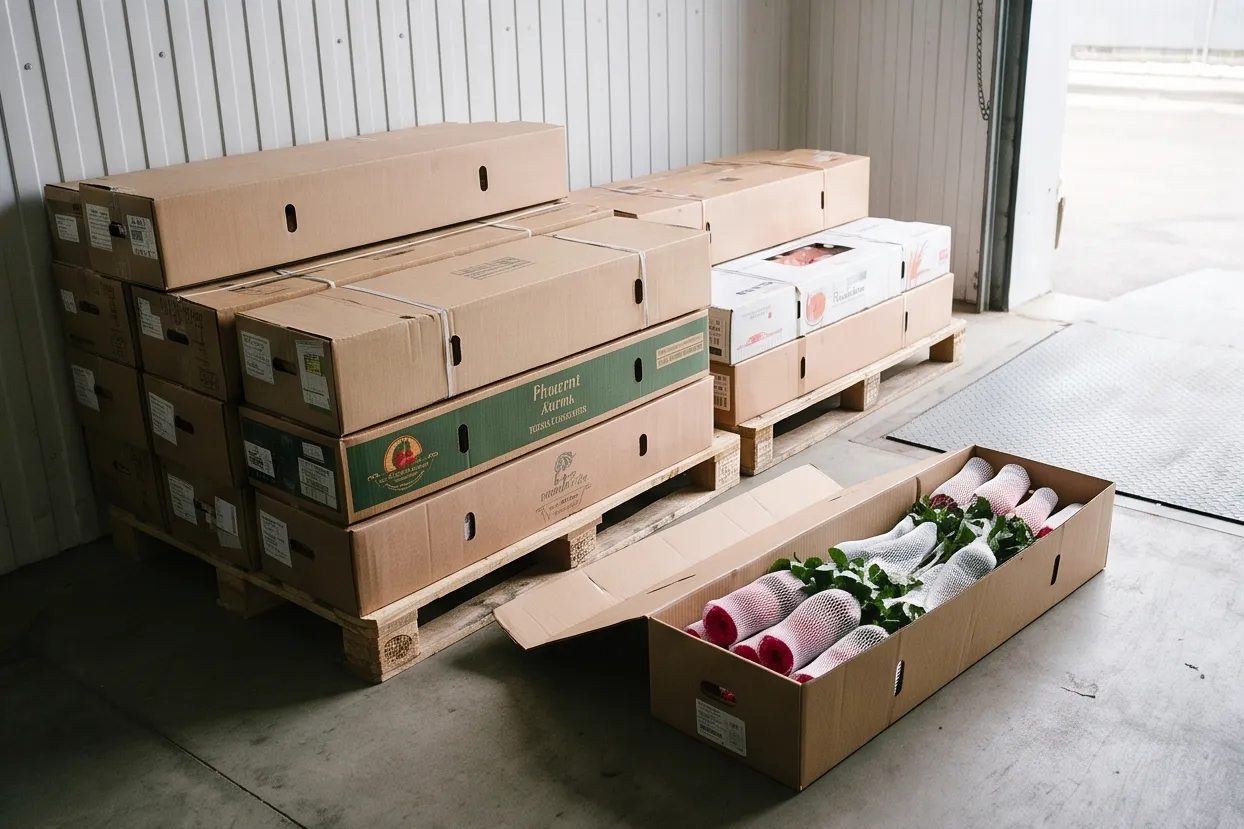
It travels dry, in boxes, by air to Amsterdam or another European hub, then by truck to the wholesaler. That explains the price: air freight is charged by weight and box volume, and a long stem takes more space. If nobody in your area asks for a 90 cm rose, there is no point paying for length: 60 cm from the same farm sells faster.
Colombia is a neighbouring source with similar transit times. From there come carnations, spray chrysanthemums, alstroemeria, hydrangea and roses. These are the flowers that fill everyday bouquets, so a Colombian supply is valued for consistency rather than show. Varieties, stem lengths and how to buy roses in volume are covered in our article on wholesale roses.
Kenya and Ethiopia: why florists buy them
Kenyan and Ethiopian farms also sit high up, but the climate and varieties differ. A typical Kenyan rose has a mid-size or small head, a 40–60 cm stem, bright colours and many spray varieties. For a shop it is a fast seller: a bouquet of 15–25 Kenyan roses costs noticeably less than the same bouquet made with Ecuadorian roses and still looks even and full.
The route from East Africa to Europe is shorter than from South America, and there are many flights, so supply stays steady through the year. Much of it is sold through the Dutch auction or Dutch importers, which is exactly why so many "flowers from Holland" were grown near the equator. Florists buy Kenyan and Ethiopian roses when they need volume at a sensible price: everyday bouquets, corporate orders, promotions. Big heads and long stems are a job for Ecuador.
An easy way to keep the difference in mind: Ecuador is size and impact, Kenya and Ethiopia are volume and price. In the shop they work well side by side, with price labels that let the customer see what the extra money buys.
European growers, Israel and the local season
Dutch greenhouses remain strong in tulips, chrysanthemums, gerbera and bulb flowers, and in spring a Dutch tulip is often the best value on the market.
Italy, Spain and France send ranunculus, anemones, mimosa, foliage and carnations, especially in winter and early spring. The route is short and goes by truck, so freshness is good and transport costs stay lower than air freight.
Local growers across Europe have become a real option for seasonal lines: British narcissi and tulips in spring, peonies and dahlias in summer, field flowers in Germany and Scandinavia. The main plus is a route of a day: a stem from a grower an hour away arrives fresher than any import and suffers less on the road. The minuses are a narrower range, often shorter stems and little choice in winter, when heating and lighting raise greenhouse costs.
Israel matters mainly for foliage: ruscus, pittosporum, waxflower. Bouquets are harder to build without them, and Israeli greens often travel via Holland in the same truck as everything else.
Seasonality: when imported flowers get more expensive
Flower imports follow two calendars: the weather at the farms and the holidays of the buyers. Farms know when demand peaks and raise prices several weeks ahead, and air freight gets more expensive when planes are full.
| Period | What happens |
|---|---|
| January to early February | Build-up to Valentine's Day: red roses get more expensive at the farms well in advance |
| March to May | Mothering Sunday in the UK in March, International Women's Day in Italy and parts of Central and Eastern Europe, Easter, then Mother's Day in most of the continent in May |
| June to August | Weddings and local field flowers; imports are cheaper, many shops sell less |
| Late October to early November | All Saints' Day: chrysanthemums and grave arrangements in France, Belgium, Germany and Poland |
| November to December | Steady demand, Christmas greens and conifers, pot plants |
In practice this means: plan holiday imports 3–4 weeks ahead, with a pre-order and a fixed price where your supplier offers one, and in summer buy more from nearby growers. Splitting a purchase by delivery dates also makes it easier to avoid waste after the holiday.
Buying flowers from Holland direct: can a shop do it
"Buy direct from Holland" is a common search, and the answer is short. Buying on the auction clock means registering as a buyer, buying in auction units of boxes and trolleys, paying promptly and arranging your own transport. Exporters' webshops are open, but they are built for importers and wholesalers with steady volume. Cut flowers imported from outside the EU need a phytosanitary certificate and plant-health checks at the border, which the importer handles. Pot plants moving within the EU need a plant passport. Since Brexit, buyers in the UK face extra paperwork and checks on flowers from the EU, and the rules have changed several times, so check the current position with your importer or the national authority.
For a single shop the realistic options are:
- A cash-and-carry or delivering wholesaler that brings in imports itself. You pay for the range and for the fact that transport and quality risks sit with them.
- Dutch van traders who drive a route and sell from the truck, or deliver to a standing order. Convenient, though prices include the trip.
- Your own import, when your purchasing regularly fills several boxes of one product and someone can handle the paperwork and claims.
How to choose between a wholesaler and an importer and what to ask each of them is in our article on flower suppliers. What happens to stems on the road and how to check a delivery is covered in transporting cut flowers.
Country and arrival date on the product card
For a buyer, the country of origin is practical information. It tells you what the head will look like, how long the rose will last and whether it can stand in the window for a week. So wholesalers that sell online put the country on the product card and in the filters.
On the websites of wholesalers that run on Petala, a product shows its country, stem length and stock, and the catalogue filters by shipment, country, stem length and colour. Goods in transit carry their arrival date and can be reserved in advance: a shop sees the Friday shipment from Ecuador on Wednesday and orders before it sells out. The cart splits such an order from items already in stock. You can see how it looks for a trade customer on the demo website.
If you run a wholesale business and want to show your imports by country and arrival date, the catalogue can come from the Petala CRM or from your own system via Excel/CSV or API, with prices and stock taken from that system. The details for your setup are easiest to sort out on a call, so get in touch.
Frequently asked questions
Which flowers actually come from Holland?
The Netherlands itself mainly grows tulips and other bulb flowers, chrysanthemums, gerbera, alstroemeria, lisianthus, hydrangea, peonies in season and pot plants. On top of that, the Dutch auction and importers trade flowers grown in Kenya, Ethiopia, Ecuador, Colombia, Israel and other countries, so one truck carries stems of many origins.
What is the difference between Ecuadorian and Kenyan roses?
An Ecuadorian rose is usually bigger: a large head and a thick stem from 60 cm upwards, longer vase life with good handling, and a higher price. A Kenyan rose has a mid-size head, a 40–60 cm stem, many spray varieties and a lower price. The first is bought for impact, the second for volume.
How long do flowers take to get from the farm to a florist in Europe?
As a rough guide, roses from Kenya or Ethiopia reach a European wholesaler in 2–4 days after cutting, roses from Ecuador or Colombia in 3–6 days. From the Dutch auction to a shop in Western Europe it is usually 1–2 days. Times stretch before big holidays and depend on flights and checks.
Can a small flower shop buy directly at the Dutch auction?
In principle a business can register as a buyer, but it then buys in auction units, pays promptly and arranges its own transport. For most single shops a cash-and-carry wholesaler, a delivering wholesaler or a Dutch van trader works out cheaper and simpler.
Why are flowers from Holland more expensive than the same roses from the farm?
Each step between farm and shop adds a margin and a cost: air freight, auction fees, the importer, the wholesaler and the truck. In return you get a wide range, small quantities and fast delivery, which a single shop could not organise on its own.
 PurchasingWholesale Roses: How to Choose Origin, Stem Length and Variety
 PurchasingTransporting cut flowers: how to get stems to the cold room without losses
 PurchasingFlower Suppliers: How to Choose and Vet Them for Your Shop