
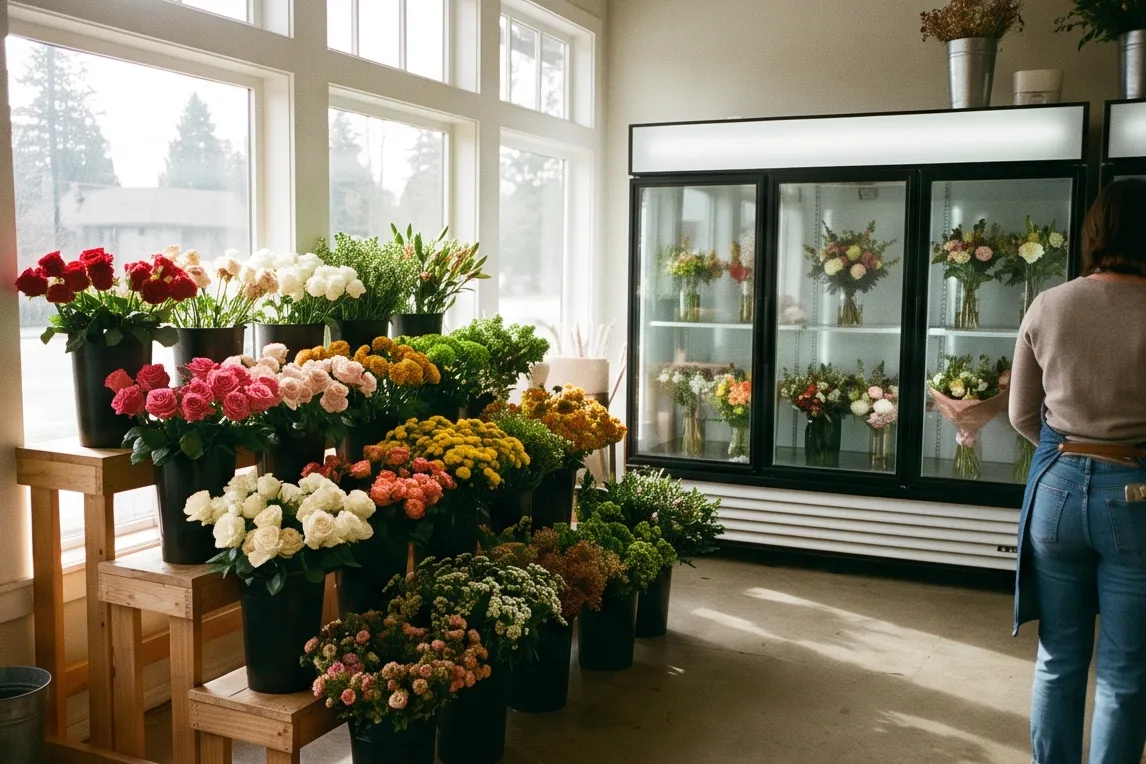
A flower shop product range rests on three layers: a core that sells all year, seasonal flowers that change every few weeks, and plants and extras that raise the average sale. The display then shows that range so a customer understands the prices and chooses within a minute, while the flowers keep their condition.
In short
- The core is roses in two or three lengths and colours, spray roses, chrysanthemums, alstroemeria, carnations, lisianthus and foliage. It usually takes the larger part of every purchase.
- The seasonal layer is two or three flowers that change with the month: tulips in spring, peonies in early summer, hydrangeas and asters in September.
- Potted plants and sundries (cards, wrapping, flower food, vases) keep takings steady in quiet weeks.
- The chilled display holds what customers choose by eye; the shop floor holds ready-made bouquets at three prices and potted plants.
- Review the range against a month of sales, not gut feeling: what sells out and what has stood in the bucket for three days.
Flower shop product range: the layers it is made of
A good flower shop product range is not the widest one. It is the one that sells before the flowers open. A neighbourhood shop carrying forty kinds of cut flowers almost always throws away more than it earns on the rare lines. So it helps to build the range in layers and give each layer a job.
| Layer | What goes in | Its job in the shop | Share of purchasing, rough guide |
|---|---|---|---|
| Core | Roses, spray roses, chrysanthemums, alstroemeria, carnations, lisianthus, foliage | Most bouquets are built from them; regulars come back for them | The larger part, in practice around two thirds |
| Seasonal | Tulips, peonies, hydrangeas, ranunculus, sunflowers, asters, by month | Refresh the display and give regulars a reason to return | Noticeably smaller, depends on the month |
| Accent | Protea, anthurium, calla, cut orchids | Make the display memorable and lift the price of premium bouquets | Small, bought to order or in small lots |
| Potted | Phalaenopsis orchids, succulents, seasonal plants | A gift that lasts; sales without three-day waste | Depends on floor space |
| Sundries | Cards, wrapping, flower food, vases, pots | Add-on sales to a bouquet | Small, but with a high margin |
The shares are a starting point for the first orders, not a rule. A kiosk in a shopping centre lives almost entirely on the core and ready-made bouquets. A studio without a shop window buys to order and keeps a minimal stock. A neighbourhood shop with a bigger floor can afford a shelf of potted plants.
The core range: flower names and why each one is there
Below is a basic set of cut flowers that works as a starting point for a neighbourhood shop. It covers most occasions, from a bouquet for a colleague to a wedding order.
| Flower | What to buy | Why it is in the range | Vase life |
|---|---|---|---|
| Standard rose | 2–3 lengths (for example 50, 60 and 70 cm); red, white, pink, cream | Single-variety bouquets, the base of most mixed ones, the main Valentine's flower | Medium, depends on the variety |
| Spray rose | 2–3 colours, light and pastel | Volume and softness in mixed bouquets, affordable arrangements | Medium |
| Spray chrysanthemum | White, yellow, lilac, santini types | Affordable volume, bouquets for men and older recipients | High |
| Disbud chrysanthemum | White and green | Structured bouquets, office arrangements | High |
| Alstroemeria | 2–3 colours | Cheap, bright colour that lasts, good in mixed bouquets | High |
| Carnation | Standard and spray, red and pastel | Memorial work, affordable single-variety bunches | High |
| Lisianthus | White and lilac | Wedding and soft bouquets, a peony substitute out of season | Medium |
| Gypsophila | White | Airy filler and single-variety bunches | Medium |
| Foliage | Eucalyptus, pittosporum, ruscus, salal | The frame and volume of a bouquet; a mixed bouquet looks thin without it | High |
Vase life is comparative: how well the flower forgives a few days on display. The lower it is, the less you hold in stock. Roses and lisianthus need frequent small deliveries; chrysanthemums and alstroemeria get through a weekend without trouble.
Mind local meaning. In France, Belgium and Italy large chrysanthemums are strongly linked to graves and All Saints' Day, so they sell as memorial flowers there, while in the Netherlands or the UK spray chrysanthemums are an everyday filler. Write labels the way customers talk: many people do not know "lisianthus", so a hint such as "looks like a rose, lasts longer" helps. How to read variety, length and origin in a supplier's price list is covered in the guide to buying wholesale flowers.
Changing the range with the seasons
The seasonal layer is the part of a flower shop product range that refreshes the display and gives regular customers a reason to come in again. Change it in step with the holiday calendar and with what is cheaper and better at your suppliers right now.
| Season | What to add | Holidays and occasions |
|---|---|---|
| December – February | Christmas greenery and decorations, amaryllis, hyacinths, first tulips, poinsettias in pots | Christmas, New Year, Valentine's Day |
| March – May | Tulips, daffodils, ranunculus, mimosa, potted hyacinths, lilac | Mothering Sunday in the UK and Ireland, Easter, Mother's Day in May on the continent |
| June – August | Peonies, sunflowers, local garden flowers, hydrangeas, field-style daisies | Weddings, graduations, summer parties |
| September – November | Hydrangeas, asters, chrysanthemums, dried flowers, potted chrysanthemums | Back to school, All Saints' Day (1 November), autumn birthdays and events |
Bring a seasonal flower in a week or two before the peak, not on the day itself: customers need time to see it in the window. Take it out just as firmly. Late-season peonies get dearer and last less, and keeping them into August out of habit is a reliable way to raise waste. Preparing the range for the biggest winter peak has its own guide: the Valentine's Day flower shop plan.
Potted plants and sundries
Potted plants sell more slowly than cut flowers, but they do not wilt in three days. For a neighbourhood shop they even out takings in summer, when people buy fewer cut flowers. Start with what people buy as gifts and what forgives care mistakes: phalaenopsis orchids, succulents in small pots, and seasonal plants such as poinsettias for Christmas, hyacinths and mini roses in spring, and potted chrysanthemums in autumn.
They need light but not direct sun, and they do not go into the cold room. So plan their place when you lay out the shop, not on a windowsill by the door where they get chilled every time it opens in winter.
Sundries (cards, cut-flower food, wrapping at different prices, simple glass vases, pots) take little space and hardly spoil. Keep them next to the till and the florist's table, not in a far corner: people pick them up at the last moment, when the bouquet is already made. How to offer them without sounding pushy is covered in the guide on how to sell more flowers.
Planning purchases around the range
Cut flowers live a short time, so plan purchases for 3–4 days of sales, not a week. Say you bought €4,000 of flowers on Friday and by Tuesday €600 of them went in the bin: that is 15% of the purchase. If waste on one line stays higher than on the others week after week, buy less of it or drop it from the range.
Once a month review the flower shop product range against three lists: what sells most by quantity, what brings in most money, and what is thrown away most often. They almost never match. White roses at 60 cm may top the count while lisianthus tops the takings, even though fewer people buy it. Decide what to add from the second list and what to cut from the third. How to break losses down by cause is explained in the article on flower waste.
Keeping these lists by hand gets hard as soon as a second person works the counter. The CRM for flower wholesalers from Petala includes a trending products report next to sales and stock reports, so you can see which lines move by quantity and by value and plan the next delivery from it. If you buy from a wholesaler whose site runs on Petala, its catalogue shows goods in transit with their arrival date, and seasonal lines can be reserved ahead of the delivery.
The chilled display: layout inside the cooler
The chilled display is the heart of the shop floor: customers choose by eye, and the florist builds the bouquet from what is visible. Cut flowers are kept at +2 to +8 °C; choosing the cooler itself, its size and lighting is covered in the guide to the flower cooler. Here is how to arrange what goes inside.
Tall at the back, short at the front. Roses at 70 cm and gladioli on the back tier, spray flowers and single-variety bunches near the glass. No flower should hide another.
Blocks of colour, not a rainbow. Put buckets of one colour next to each other. A block of red, white or pink reads from the street; a mixed row of twenty buckets blurs into one.
Older stock nearer the customer. Flowers from the previous delivery go in front, fresh ones behind. That way what has been standing longer sells first.
The morning round. Every morning remove anything that has started to open too far or droop. One sagging stem makes the whole bucket look tired. Fully open roses still work in ready-made bouquets at a discount today, not tomorrow.
Tropicals stay out of the cold. Anthuriums, strelitzias and cut orchids are kept on the shop floor, away from the door; in a cooler they get chill damage.
Window and shop-floor display
The window and the table on the shop floor work for different customers. The window sells to people walking past; the table sells to someone who is already inside and in a hurry.
The window. Put one large arrangement there, tied to the season or the next occasion, not a store of buckets. Change it for each one: back to school, Christmas, Valentine's Day, Mother's Day. Do not put cut flowers in a sunny window, they heat up within an hour; a south-facing window suits dried flowers, artificial decoration or potted plants that cope with light. In the evening the window should glow: in winter most passers-by come after dark.
The ready-made bouquet table. Keep ready-made bouquets at three price points at eye level, each with its own price. A customer in a hurry chooses from what is already made.
Price labels. Every line needs a name and a price: per stem for cut flowers, per item for bouquets and plants. A customer who cannot see the price often does not ask and leaves. What a price label must show varies by country, so check the consumer rules with your accountant or trading standards office. If bouquet prices change with each delivery, use labels that are easy to swap. How to set the price itself so it covers waste and the florist's time is explained in the guide on how to price a bouquet.
Frequently asked questions
What flowers should a new flower shop stock?
A core of roses in two or three lengths and colours, spray roses, chrysanthemums, alstroemeria, carnations, lisianthus and foliage, plus two or three seasonal flowers. Add a few potted plants and sundries by the till. Buy for 3–4 days of sales and after a month remove what is regularly thrown away.
What are the best selling flowers in a flower shop?
All year round, roses (especially red and white of medium length), spray chrysanthemums and alstroemeria usually move best, because they are affordable and last. But the real answer for your shop comes only from your own sales records: two shops in the same area can sell quite different things depending on their customers.
Does a flower shop need a refrigerated display?
For cut flowers, yes: without a chilled display they lose condition in a day or two, and waste eats the markup. Potted plants, tropical cut flowers and sundries stay on the shop floor. A kiosk can manage with a display cooler; a neighbourhood shop with two deliveries a week usually needs a cold room as well.
How do I set up a flower shop window display?
One seasonal arrangement that you change for each occasion, not a store of buckets. Keep cut flowers out of direct sun, light the window in the evening, and inside the shop place tall flowers at the back, short ones at the front, with a price on every line.
How often should a florist change the range?
The core changes rarely, after a month of sales figures. The seasonal layer changes every few weeks, following the holiday calendar and what suppliers offer. Bring new lines in a week or two before the occasion so customers have time to notice them.
 Sales & marketingHow to sell more flowers: average order, add-ons and loyal customers
 PurchasingWholesale Flowers for Your Shop: Where to Buy and How Not to Overpay
 Pricing & marginsHow to price a bouquet: from cost price to the price tag