
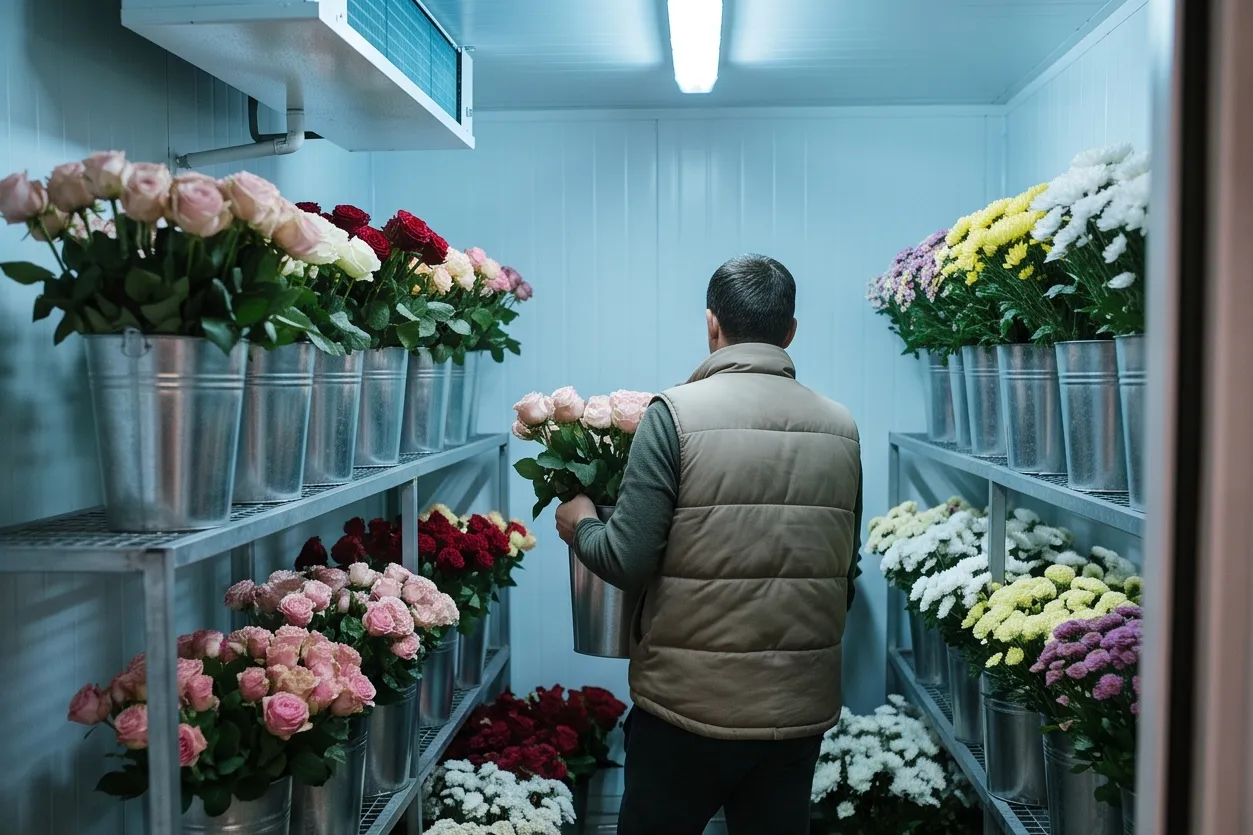
A flower cooler in a shop usually means two things: a display cooler that shows bouquets to customers and a walk-in cold room where stock waits between deliveries. Cut flowers need +2 to +8 °C and around 80–90% humidity, and the size is chosen from the biggest delivery of the week, not from the floor space you have.
In short
- A market stall or kiosk can start with a display cooler alone; a neighbourhood shop with two deliveries a week almost always needs a cold room as well.
- Keep +2 to +8 °C without swings: temperature jumps and condensation damage flowers faster than one degree too many.
- Size from your Friday delivery plus room for holidays, not from what fits in the shop.
- Tropical flowers such as anthurium, strelitzia and orchids do not go in the shared cold: they need about +12 to +15 °C.
- As a rough guide for autumn 2026, a new display cabinet costs €2,000–6,000 and a small walk-in cold room with installation €5,000–12,000; prices vary a lot by country, city and specification.
Which flower cooler a shop needs: display, cold room or both
A display cooler and a cold room do different jobs, and mixing them up is expensive. The display sells: glass, lighting, shelves and buckets arranged so the customer sees bouquets from the door. The cold room stores: nothing pretty, just volume, even cold and space for the boxes from the morning delivery.
Display coolers come in three main types. A cabinet with hinged or sliding glass doors stands against a wall and takes the least space. An open multideck with an air curtain is convenient for customers but uses more electricity and dries flowers more. Corner and island displays are made to order for small or awkwardly shaped shops.
A walk-in cold room is an insulated room built from sandwich panels with a refrigeration unit or a split system. It sits in the back room and holds everything that does not fit in the display: spare roses, foliage, boxes for pre-orders.
How to choose between them:
- deliveries three or more times a week, modest sales: a display cooler is enough;
- deliveries twice a week, a wide range, corporate orders: display plus cold room;
- a floral studio without a shop window, working to order: a cold room or a large cabinet without lighting.
If you are unsure, start with the display and keep space in the floor plan for a cold room: adding one after six months is easier than rebuilding the back room. The full startup budget, cooling included, is covered in our article on flower shop startup costs.
Flower cooler temperature and humidity
The working range for most cut flowers is +2 to +8 °C. Roses, tulips, chrysanthemums, carnations, alstroemeria and foliage keep best near the lower end, around +2 to +5 °C. A display that is opened all day usually runs warmer, at +5 to +8 °C, and that is fine: flowers stand there for a day or two, not a week.
Stability matters more than the exact number. Each time the door opens, warm air comes in, condensation forms on cold petals and film, and a damp, warm corner is ideal for grey mould. So:
- keep a thermometer that records minimum and maximum: in the morning you see what happened overnight;
- do not set the temperature close to zero "to be safe": some flowers darken at 0 °C and below, and water in buckets near the evaporator can freeze;
- after taking in a delivery, let the cold room return to its set point before opening it every five minutes again.
Humidity should be around 80–90%. Air that is too dry pulls water from the petals, and a rose can lose its looks overnight. Air that is too damp and still brings mould on the buds. A simple hygrometer costs little and pays for itself with the first bucket it saves.
Ethylene is a separate issue. Fruit, wilting flowers and rotting leaves give off a gas that speeds up opening and dropping. Keep no food in the flower cooler and clear out old stems and leaves daily. Conditioning, water and recutting are covered in detail in our article on storing cut flowers.
How big: shop format and cooler size
The most common mistake is buying equipment to fit the shop floor. The right calculation starts from the delivery: how many boxes and buckets arrive on the busiest day and how many of them do not sell straight away.
Work it out like this. Purchases usually cover 3–4 days of sales. Write down how many buckets that purchase fills once unpacked, add a third for reserve and growth, and add space for buckets of finished bouquets. For Valentine's Day and Mother's Day you need two or three times the usual volume, but buying permanent cooling for a few days a year does not pay: rent an extra cooler or arrange more frequent deliveries with your wholesaler.
| Format | What goes in | Volume, rough guide | Who it suits |
|---|---|---|---|
| Studio working to order | Cabinet without lighting or a small cold room | 0.5–1.5 m³ | Florists doing weddings, events and corporate work, buying per order |
| Kiosk in a shopping centre | Display cabinet 1–1.5 m | 0.8–1.5 m³ | Ready-made bouquets, deliveries 3–4 times a week |
| Market stall or street kiosk | Display 1.5–2 m, sometimes a small cold room | 1.5–3 m³ | Passing trade, single-variety bunches, frequent small purchases |
| Neighbourhood shop | Display 2–3 m plus cold room | Display 2–3 m³, cold room 5–10 m³ | Wide range, deliveries twice a week |
| Small wholesaler or large studio's store | One or two cold rooms | From 15–20 m³ | Stock for several customers, pre-orders for a shipment date |
These figures are a starting point for your first talk with a refrigeration supplier, not a standard. Bring two facts: your biggest weekly purchase in buckets and the room dimensions including door openings. Without them any volume estimate is a guess.
Airflow, drying and condensation: why flowers spoil in a working cooler
Sometimes the flower cooler works, the thermometer reads +4 °C, and the roses still dry at the petal edges. The cause is usually the air, not the temperature.
In fan-assisted displays and cold rooms the cold stream comes from the evaporator. Flowers standing right under it dry out overnight because dry air is blowing on them. Hence the rules for placing buckets:
- keep buckets 10–15 cm away from the fan grille and from the back wall with the evaporator;
- keep delicate flowers such as hydrangea, ranunculus and lisianthus away from the airflow, and put sturdy chrysanthemums and foliage closer;
- do not pack shelves so tightly that air cannot pass: dead corners are warmer and damper, and that is where mould starts.
Condensation is the second enemy. It forms when warm shop air reaches cold flowers and film. Unpack delivery boxes in the cold room or straight after checking them, rather than leaving them wrapped in the warm shop and then putting them in the cold. Damp packaging in the cold leads straight to grey mould on the buds.
The third is defrosting. The evaporator defrosts from time to time, and the temperature rises a couple of degrees. That is normal, but if defrosting happens too often or water drips from the evaporator onto the flowers, call an engineer: it will only get worse.
Lighting, glass and shelving
Lighting in a display sells, but it also heats. Old incandescent and halogen lamps inside the cooled space raise the temperature noticeably; LEDs barely do. When buying a display, ask what lighting it has, and with a used one, check whether it has been replaced with something home-made.
Display glass should be double-glazed, not single: otherwise it mists up inside in frost and heats up from outside in summer. Do not place the display by the entrance or by a south-facing window: sun through glass works like a heater, and the compressor never switches off.
Shelving is made for buckets, not boxes: wire or stainless steel, adjustable in height. Roses of 70–80 cm and low single-variety bunches do not fit on the same level, so it helps to have at least two shelf heights. The floor of both the display and the cold room must be easy to clean, because water from buckets spills every day.
Customers notice the cabinet colour too. A black flower cooler looks sharper and sets off pale bouquets, a white one suits a bright interior. This is a design choice: colour does not affect the cold.
Refrigeration units, split systems and electricity
A cold room is cooled by a monoblock mounted on its wall or by a split system with an outdoor unit. A monoblock is simpler to install but noisy and warms the back room. A split system moves the compressor and its heat outside but needs pipework and the landlord's consent for the outdoor unit.
People often ask about using an ordinary domestic air conditioner instead of a commercial unit. A domestic unit is designed to cool to roughly +16 to +18 °C and will not go lower without modification. Controllers sold for this purpose trick the air conditioner's sensor into holding +4 to +6 °C, and low-cost DIY cold rooms are built around them. It works, with caveats: the evaporator can ice up, the domestic compressor wears faster in this mode, and the warranty is usually lost. For a studio this is a reasonable saving; for a shop whose cold room holds several thousand euros of stock, a commercial unit is the safer choice.
Check the electricity supply before signing a lease. The display, the cold room, lighting and winter heating run at the same time, and a compressor's start-up current on a weak line trips the breaker. Ask the equipment supplier for the total power and compare it with the capacity of the premises. Estimate monthly consumption from the equipment specifications and your business tariff: it is noticeably higher in summer than in winter. EU F-gas rules are phasing out some older refrigerants, so ask a certified refrigeration engineer which refrigerant a unit uses.
What stays out of the cold: tropical flowers and pot plants
Not every flower likes cold. Tropical cut flowers such as anthurium, strelitzia, heliconia, alpinia and many orchids get chilling injury at +2 to +5 °C: petals darken in patches, bracts lose their shine, and there is no way back. For them the guide is about +12 to +15 °C.
What to do with them in an ordinary shop:
- keep them on the shop floor away from the door and the cold display, on a separate shelf out of draughts;
- buy small amounts more often: tropicals are expensive, and one spoiled bucket can eat a week's margin;
- if you sell a lot of them, use a separate cabinet set warmer: glass-door wine and bar coolers hold +10 to +16 °C and work well.
Pot plants do not go in the cold room either: they need light, and a few days of cold and dark weaken them. Their place is on the shop floor near a window, out of direct sun.
How much does a flower cooler cost: new, used, small
Prices below are a rough guide for autumn 2026 in a large Western European city; they are higher in Amsterdam, Paris or London and depend on the manufacturer, size, specification and installation. Ask for two or three quotes with the same scope, or there is nothing to compare.
| Item | New, rough guide | What drives the price |
|---|---|---|
| Small glass-door cabinet (bar or wine cooler) | €400–1,500 | Volume, temperature range; suits a studio and tropical flowers |
| Display cabinet 1–1.5 m | €2,000–6,000 | Doors, lighting, type of cooling |
| Multideck, corner or custom display 2–3 m | €5,000–15,000 | Size, non-standard shape, remote condensing unit |
| Walk-in cold room 5–10 m³ with unit and installation | €5,000–12,000 | Panel thickness, monoblock or split, pipework, floor |
A used flower cooler is a sensible way to save; it often sells for around half the price of a new one. Used displays come up when shops close, often after the summer slowdown. Before buying:
- ask for the unit to be switched on and run for an hour: the thermometer should reach +2 to +8 °C and hold it;
- check the door seals, corrosion on the evaporator and oil traces on the pipes;
- find out which refrigerant it uses and whether it can still be serviced where you are;
- budget for transport, installation and an engineer's check, which for a cold room is a noticeable part of the cost.
A home-built cold room is the cheapest option, but its price is risk: if the unit stops overnight in a heatwave or a frost, you find out in the morning, with all your stock at once.
Order in the cooler and stock records
Even a perfect cold room will not save a forgotten bucket in the back corner. Waste in flowers comes less often from breakdowns and more often from old stock standing behind new deliveries, untouched.
Simple rules help. New deliveries go to the back, older ones move to the front. Each bucket carries its arrival date in marker on a strip of tape. Once a day a florist walks through the cold room and moves into the display and into bouquets whatever needs to sell today. How to analyse losses and reduce them is covered in our article on flower waste.
The other half is records. If your records say 50 'Explorer' roses are in the cold room and the florist counts 30, either some went into bouquets without being logged or a bucket stands in the display under another name. In a CRM for flower wholesalers such as Petala, stock is kept per warehouse and per branch if you have cold rooms at several sites, write-offs are recorded with the stock, and the stock report shows what is left. An evening check of the cold room against the records takes minutes, not an evening with a notebook.
Frequently asked questions
What temperature should a flower cooler be set to?
For most cut flowers, +2 to +8 °C: closer to the lower end in a cold room, around +5 to +8 °C in a display that is opened often. Tropical flowers such as anthurium, strelitzia and orchids need about +12 to +15 °C, or they darken.
How much does a flower cooler cost?
As a rough guide for autumn 2026: a small glass-door cabinet €400–1,500, a 1–1.5 m display cabinet €2,000–6,000, a 5–10 m³ walk-in cold room with installation €5,000–12,000. Used equipment often costs around half, but test it running before you buy. Prices vary by country and city.
Can I use a normal fridge for flowers?
A domestic fridge with a solid door works only for a couple of buckets held for an order: it is cramped and dry, and flowers near the freezer section get frost damage. A display needs a glass-door cabinet with even airflow, and stock needs a cold room.
Can I build my own flower cooler?
You can build a cold room from sandwich panels and a domestic air conditioner with a controller that makes it hold +4 to +6 °C. It is cheaper than a commercial unit, but the evaporator can ice up, the compressor wears faster and the warranty is usually lost. For a studio it is a reasonable option; for a shop with a lot of stock, commercial equipment is more reliable.
Which flower cooler is best for a small shop?
A kiosk or market stall can manage with a 1–1.5 m glass-door display cabinet with LED lighting if deliveries come three or four times a week. If deliveries are less frequent or the range is wide, add a small cold room in the back. How to plan the whole launch is covered in our guide on how to open a flower shop.
 Storage & stockStoring cut flowers: how to make stems last longer in your shop
 Storage & stockFlower waste: normal levels, causes and how to reduce it
 Starting outFlower Shop Startup Costs: A Line-by-Line Budget