
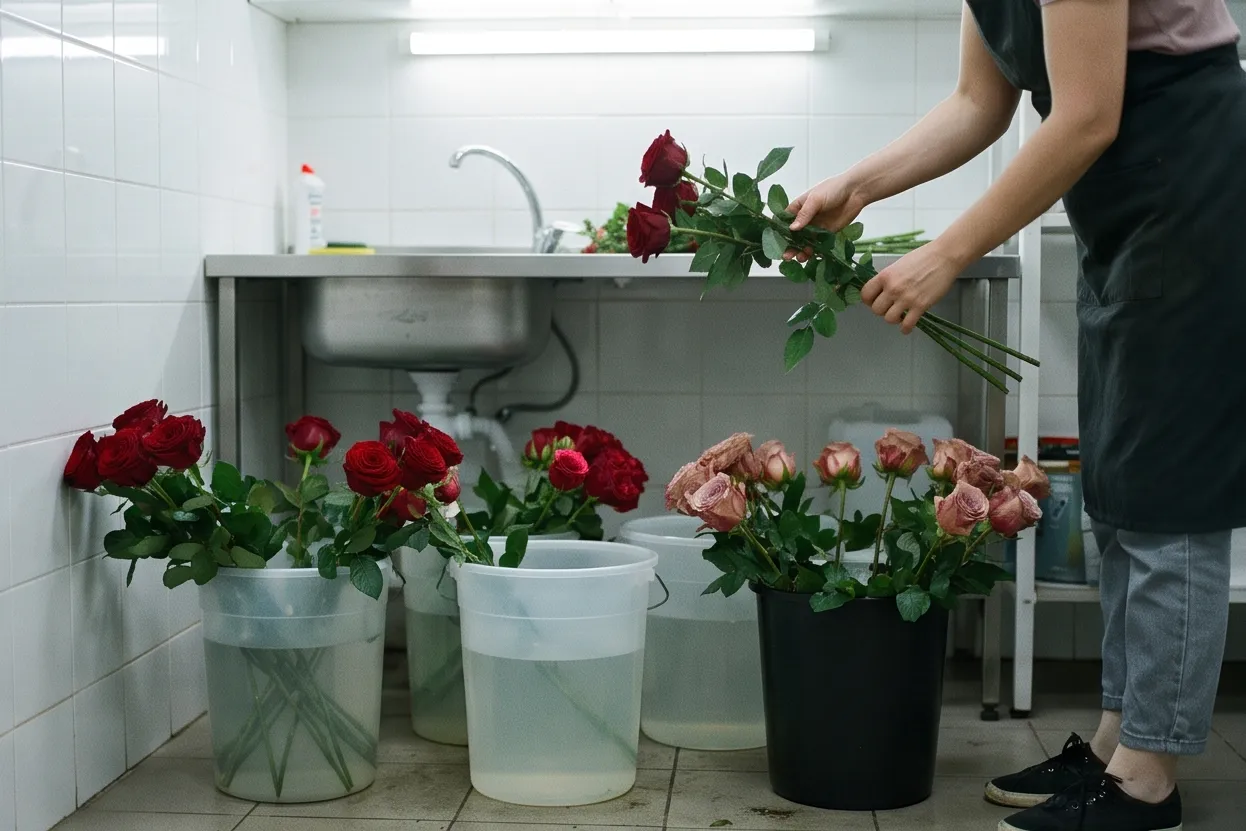
Storing cut flowers rests on four things: cold at +2 to +8 °C, clean water with flower food, a fresh cut, and an order in which whatever arrived first sells first. If one of the four slips, flowers lose their looks a day or two early, and those days go straight into waste.
In short
- Most cut flowers are kept at +2 to +8 °C: nearer +2 to +5 °C in the cold room, warmer in the display because the door keeps opening. Anthurium, orchids and other tropicals need at least +12 to +15 °C.
- Every delivery is conditioned: recut, water with flower food, a few hours in the cold, and only then the display or bouquets.
- A dirty bucket kills flowers faster than a warm room: bacteria block the stems and the flower stops drinking.
- Buckets are labelled with their arrival date and sold in turn: older stems into bouquets and promotions, new ones into reserve.
- A short care card for customers makes bouquets last longer and cuts down on "they died in two days" complaints.
Storing cut flowers: what decides vase life
A cut flower lives on the sugars and water it has left. Cold slows its breathing and the use of that reserve, water with flower food tops it up, and bacteria and ethylene shorten it. Every storage rule follows from this: keep it cold, let it drink, and remove whatever speeds up ageing.
Ethylene is a gas given off by fruit, wilting flowers and even the exhaust of a van at the door. Carnations, alstroemeria, gypsophila, lilies, delphinium and snapdragons are especially sensitive: buds drop and petals fade early. So keep no fruit or staff lunches in the cold room, and take spent stems out of the buckets every day, not once a week.
Humidity matters too. Dry air pulls water out of petals, so buckets should not stand right in the airflow from the cooler fan, and the cold room should be kept humid. How to choose the cooler itself and size it to your deliveries is covered in our article on the flower cooler.
Conditioning flowers after delivery
Conditioning is preparing a delivery for storage: flowers that travelled dry in a box need a drink before they go on display. A batch put into buckets without recutting drinks poorly and opens unevenly.
The routine for most cut flowers:
- Unpack in a cool room, not on the warm shop floor: a sudden move from cold to warm causes condensation and a risk of grey mould.
- Strip any leaves that would sit in the water: in water they rot and feed bacteria.
- Recut the stems by 2–3 cm at an angle with a sharp knife or secateurs. A blunt blade crushes the stem, and it drinks less.
- Put them straight into a clean bucket with water and cut flower food at the dose the manufacturer gives.
- Leave them in the cold room for a few hours, usually 2–4, and overnight for roses after a long dry journey.
Some crops have their own rules. Narcissi release a sap that harms other flowers, so they stand on their own for the first hours and are not recut afterwards. Gerbera get only a few centimetres of water, or the stems rot. Hydrangea drinks a great deal, and a drooping head can often be revived by submerging it briefly in cool water.
How to check a delivery and what counts as damage is covered in our article on transporting cut flowers: conditioning starts where checking the delivery ends.
Water, flower food and clean buckets
The main enemy of the stem is bacteria. They multiply in the water, block the stem's vessels, and the flower stops drinking even in a full bucket. From the outside it looks like wilting for no reason: the head droops although there is water.
What works:
- Wash buckets after every use with detergent, and once a week with a disinfectant. Rinsing with water is not enough: a bacterial film stays on the walls.
- Change the water every 1–2 days, or as the flower food instructions say. Cloudy water means change it now.
- Use cut flower food. It contains sugar for nutrition, an acidifier that helps the stem drink, and an antibacterial agent. Sugar without the other two only feeds bacteria, so home recipes are no substitute in a shop.
- Set the water level by crop. Roses and chrysanthemums deep enough, gerbera and bulb flowers shallow.
- Recut at every water change, by at least 1 cm, to open a fresh cut.
Clean buckets cost almost nothing and save a noticeable share of waste. If staff wash buckets "when there is time", make it part of each shift's duties with a tick in a log.
Temperature for storing cut flowers by crop
The general guide for storing cut flowers is +2 to +8 °C. Within that range crops behave differently: one cold room suits most of them, and tropicals need a separate warmer corner.
| Crop | Storage temperature, rough guide | How long to hold before sale, usually | What matters |
|---|---|---|---|
| Roses | +2 to +5 °C | up to 5–7 days from arrival | The longer in the cold room, the less vase life is left for the customer |
| Chrysanthemums, spray and disbud | +2 to +5 °C | up to 7–10 days | Leaves yellow first; strip them |
| Carnations, alstroemeria | +2 to +5 °C | up to 7 days | Sensitive to ethylene; alstroemeria leaves yellow |
| Tulips | +2 to +5 °C | 3–5 days | Keep growing in water and bend to light; store upright |
| Gerbera, sunflowers | +4 to +8 °C | 3–5 days | Little water for gerbera, plenty for sunflowers |
| Hydrangea, dahlias | +4 to +8 °C | 2–4 days | Heavy drinkers; dahlias are short-lived |
| Protea | +2 to +6 °C | up to 7 days | Leaves blacken; flower food with sugar and light help |
| Anthurium, orchids, heliconia | +12 to +15 °C | up to 7 days | Normal cold room temperatures cause dark patches within a day or two |
The cold room and the display work differently. The cold room holds a steady temperature and keeps the reserve. The display is opened all day and runs a few degrees warmer, so it should hold only what sells in a day. Keep a thermometer in both and note readings morning and evening: night-time swings, when nobody is watching, only show up this way.
If you sell few tropicals, keep them on the shop floor away from the door and radiators, not in the shared cold room. Chilling injury on anthurium is invisible on the first day, and the customer finds the damaged flower at home.
Stock rotation: first in, first out
"First in, first out" sounds obvious, yet in a shop it gets broken every day, and no cold room can save the business of storing cut flowers if batches are not sold in turn. Staff put the prettier fresh delivery in the display, and yesterday's roses go in the bin three days later.
How to keep order:
- Label each bucket with its arrival date. A coloured tag per weekday reads faster than writing: blue for Monday, yellow for Thursday.
- New to the back, old to the front. In the cold room and in the display.
- Older stems into bouquets. Flowers on their second or third day go into mixed bouquets and arrangements first; whole bunches come from the fresh delivery.
- Discount before it is too late. If a batch is not moving, cut the price on day three rather than writing it off on day five.
Buying for 3–4 days of sales makes rotation easier on its own: there is simply less old stock. Say you bought €4,000 of flowers and €600 of it, 15%, went in the bin. If even a third of that waste is batches that sat in the cold room while the fresh delivery sold, date tags would bring back about €200 per purchase. How to break waste down by cause and reduce it is covered in our article on flower waste.
When you handle many batches, it helps to mirror the tags in your records. In a CRM for flower wholesalers such as Petala, every delivery records its arrival day, supplier and invoice, so you can see which batch came in first. Time-limited promotions on a product or category can be set there too, with a start and an end date, so a discount on slow stock does not run longer than it should.
Storage at a wholesaler: what changes
At a flower wholesaler the same rules apply on a larger scale. There are usually several cold rooms: for the main range, for tropicals, sometimes for foliage and a separate one for dispatch. The conditioning area should sit next to goods-in, so dry boxes do not wait in a warm corridor.
The main risk in a warehouse is that the stock in the cold room and the stock in the records drift apart. A sales rep promises a customer a hundred roses, and only seventy good ones are left on the shelf, the rest went to damage. The more closely records follow the cold room, the fewer of those calls you get. On a Petala website, trade customers see the stock from the same system your warehouse team updates, including goods in transit with their arrival dates. You can see how it looks for a buyer on the demo website.
How to make cut flowers last longer: a care card for customers
A customer whose bouquet lasted a week comes back. A customer whose roses drooped on day two decides you sell old stock, even if the radiator was to blame. A short care card in the bouquet or on your website prevents most of these complaints.
General advice for any bouquet:
- Recut the stems by 2–3 cm with a sharp knife and put them straight into water.
- Remove any leaves that would sit in the water.
- Add the sachet of flower food if there is one. If not, change the water every day.
- Keep the vase away from radiators, direct sun and the fruit bowl.
- Every two days recut the stems and wash the vase.
What to add for specific flowers:
- Roses: if the neck droops, recut the stem and stand the rose in deep cool water for a couple of hours with the head wrapped in paper.
- Chrysanthemums: they outlast most flowers, often two weeks or more, if yellowing leaves are removed and the water is changed.
- Hydrangea: a wilted head can be submerged in cool water for 30–60 minutes and often recovers.
- Dahlias and sunflowers: dahlias last only 3–5 days, which is worth saying at the till. Sunflowers need a deep vase and frequent water changes.
- Alstroemeria and asters: strip the lower leaves, which yellow first.
- Protea: lasts a long time and dries well if kept cool; remove blackened leaves.
Frequently asked questions
What temperature should cut flowers be stored at?
For most cut flowers, +2 to +8 °C: nearer +2 to +5 °C in the cold room for reserve stock, slightly warmer in the display. Tropical flowers such as anthurium, orchids and heliconia are kept at +12 to +15 °C, because a normal cold room gives them chilling injury.
What does conditioning flowers mean?
It is preparing a delivery for storage: recutting the stems, removing the lower leaves and leaving the flowers for a few hours in clean water with flower food in the cold. Without it, flowers that travelled dry drink less and fade sooner.
How do I keep cut roses fresh for longer?
In the shop, store them at +2 to +5 °C in clean buckets with flower food and sell them in order of arrival. At home, recut the stems, change the water and keep the vase away from radiators and fruit. A drooping neck can often be saved by recutting and a couple of hours in deep water.
Can I store cut flowers in a normal fridge?
For a small amount and a short time, yes, but never next to fruit or vegetables, or ethylene will speed up wilting. A domestic fridge is often colder than it seems, and flowers near the back wall can freeze, so check it with a thermometer.
How long can cut chrysanthemums be stored?
Chrysanthemums are among the longest-lasting flowers: in a cold room at +2 to +5 °C usually up to 7–10 days, and then they last a long time at the customer's home too. Leaves usually spoil first; strip them and the flowers stay in good shape.
 Storage & stockFlower cooler: how to choose a display cooler or cold room for your shop
 Storage & stockFlower waste: normal levels, causes and how to reduce it
 PurchasingTransporting cut flowers: how to get stems to the cold room without losses