
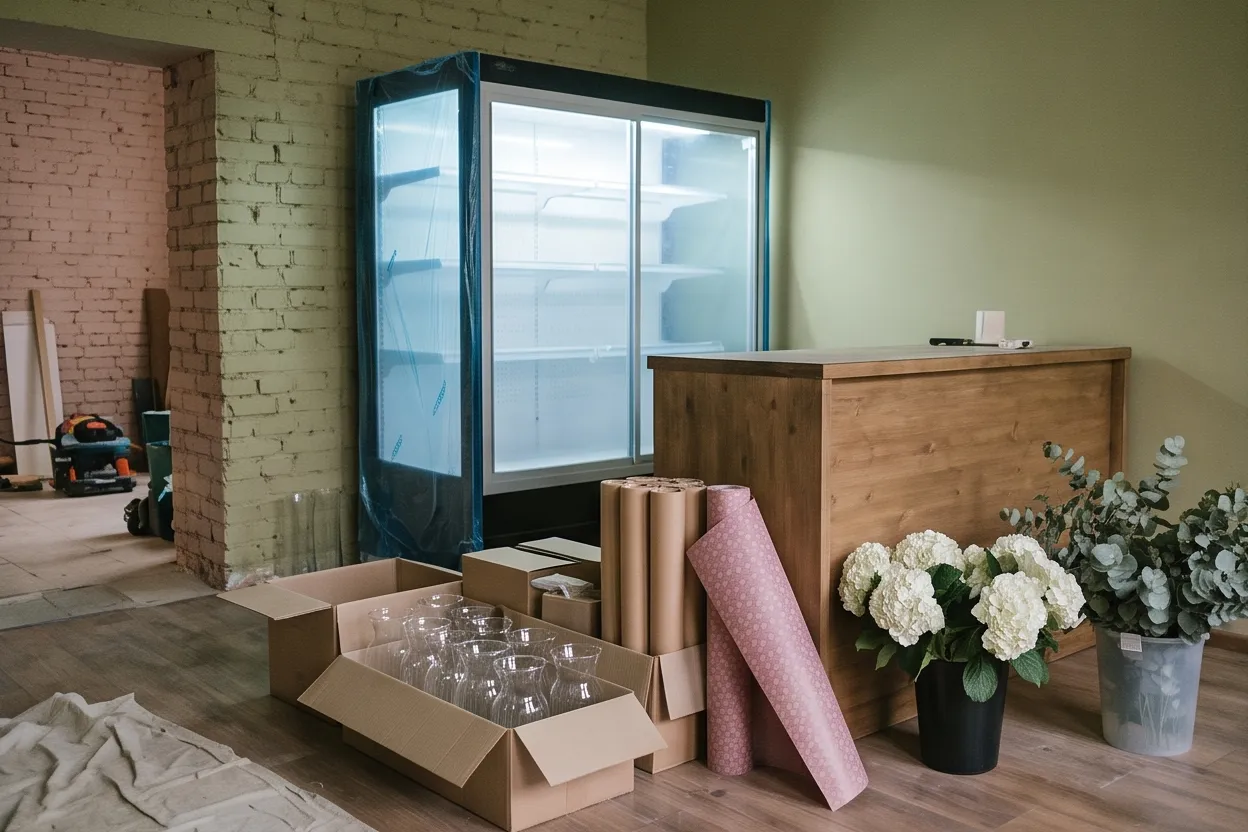
Flower shop startup costs depend first of all on the format: as a rough guide for autumn 2026, a kiosk or market stall starts from €15,000–30,000, a delivery studio without a window from about €19,000–37,000, and a neighbourhood shop with a cold room from €40,000–80,000. Costs are higher in Amsterdam, Paris or London, and none of these sums includes the reserve for 3–4 months of rent and wages, which you keep separately.
In short
- The biggest lines are fit-out, cooling, and rent with deposit. The first flower order costs less than most people expect.
- The reserve for 3–4 months of rent and wages adds roughly €13,500–42,000 on top, depending on format and on whether you work behind the counter yourself.
- Keep a contingency of about 10% of the budget: display lead times and electrical work almost always add costs.
- Do not save on the cooler or the till. You can save on furniture and signage.
- A website with a catalogue does not have to be built from scratch: a subscription costs a monthly fee rather than a large one-off sum.
Flower shop startup costs: three scenarios
First the overall picture, then a budget for each line. All figures are indicative for autumn 2026 in a mid-sized European city, excluding VAT. In capital cities rent, deposits and fit-out rise first, so recheck those lines against local listings before trusting the total.
| Format | Floor space | Spend before opening | Reserve for 3–4 months | Total with reserve |
|---|---|---|---|---|
| Kiosk or market stall | 6–12 m² | €15,000–30,000 | €13,500–18,000 | €28,500–48,000 |
| Delivery studio, no window | 20–40 m² | €19,000–37,000 | €13,500–18,000 | €32,500–55,000 |
| Neighbourhood shop with cold room | 30–60 m² | €40,000–80,000 | €16,500–42,000 | €56,500–122,000 |
Spend before opening is everything you pay before the first sale: rent and deposit, fit-out, equipment, the till, signage, the first stock. The reserve is money that sits in the account and pays rent and wages while the shop builds its customer base. How to organise the launch itself, week by week, is covered in our guide on how to open a flower shop; this article is only about money.
Three lines decide most of your own total: fit-out, the cold room and rent. Flowers, packaging and the till differ between a kiosk and a shop by a factor of two at most, while fit-out can differ tenfold.
Kiosk or market stall budget
A kiosk in a station or shopping centre is the fastest and cheapest way in: the unit is heated, lit and secure, and fit-out is minimal. The trade-off is expensive square metres, the centre's opening hours and little room for stock.
| Line | Rough guide, € |
|---|---|
| Rent, first month | 1,000–2,000 |
| Deposit, often 1–3 months' rent | 2,000–4,000 |
| Unit fit-out, lighting, work counter | 4,000–7,000 |
| Refrigerated display | 3,500–6,000 |
| Till and card terminal | 500–1,500 |
| Signage and landlord approval | 500–1,500 |
| First flowers and greenery | 1,500–2,500 |
| Packaging, buckets, vases, tools | 800–1,500 |
| Registration, insurance, sundries | 500–1,000 |
| Website, app and CRM: setup plus first month | 129 + 129 |
| Contingency | 1,500–2,500 |
| Total | about 16,100–29,800 |
Shopping centres often require their own design for the unit and approve it separately, so ask for the rules before ordering anything. The display is built to order over several weeks and is the longest lead time in the budget. How to choose one and how much capacity you need is covered in our article on the flower cooler.
A market stall replaces the fit-out with a van, a gazebo and a pitch fee, and the total lands in a similar range. The reserve for a kiosk: rent €1,500 plus one employee at about €3,000 a month including employer costs gives €4,500 a month, or €13,500–18,000 for 3–4 months. Wages vary by country, so use local figures.
Neighbourhood shop with a cold room
A street-level shop in a residential area is built for the long term: space for a cold room, a display, potted plants and a workbench. That is where the budget goes, mainly into fit-out and cooling.
| Line | Rough guide, € |
|---|---|
| Rent, first month | 2,000–3,500 |
| Deposit, often 2–3 months' rent | 4,000–9,000 |
| Fit-out: electrics, water and drain, floor, lighting | 10,000–22,000 |
| Walk-in cold room, installed | 8,000–14,000 |
| Refrigerated display | 4,000–7,000 |
| Workbench, shelving, stands | 2,000–4,000 |
| Signage | 1,500–3,000 |
| Till and card terminal | 500–1,500 |
| First stock: cut flowers, greenery, potted plants | 2,500–4,000 |
| Packaging, vases, buckets, tools | 1,500–2,500 |
| Registration, insurance, professional fees | 1,000–2,000 |
| Website, app and CRM: setup plus first month | 129 + 129 |
| Contingency | 3,500–6,000 |
| Total | about 40,800–78,800 |
Fit-out gets expensive because of three things a listing never shows: electrical capacity, a sink with a drain, and a floor that copes with water from buckets every day. If the supply cannot run the cold room, display and heating together, an upgrade from the grid operator costs both time and money. Ask the landlord before signing.
The reserve depends on who stands behind the counter. Say rent is €2,200 and one florist costs €3,300 a month including employer costs, while you cover the second shift: that is €5,500 a month, or €16,500–22,000 for 3–4 months. With rent nearer €4,000 and two employed florists, the reserve grows to about €32,000–42,000.
Delivery studio: where the money goes without a window
A studio that sells through its website, social media and phone saves on location: it does not need a street-level unit with footfall, so a courtyard or first-floor space works. The money moves into other lines: photography, advertising and delivery.
| Line | Rough guide, € |
|---|---|
| Rent and deposit | 2,500–5,000 |
| Simple fit-out: lighting, water, workbench | 3,000–6,000 |
| Cooler cabinet or small cold room | 3,500–7,500 |
| Shelving, tables, storage | 1,500–3,000 |
| Till, card terminal, online payments | 300–1,000 |
| First stock | 2,000–3,500 |
| Packaging, delivery boxes, vases | 1,500–2,500 |
| Product photography and launch advertising | 2,000–4,000 |
| Website, app and CRM: setup plus first month | 129 + 129 |
| Registration, insurance, sundries | 500–1,000 |
| Contingency | 1,500–3,000 |
| Total | about 18,600–36,800 |
We left a vehicle out. At the start, deliveries usually go to courier services paid per order, or through relay networks and delivery platforms that take a commission. Your own van and driver pay off once deliveries are steady on ordinary days, outside the Valentine's Day and Mother's Day rush. The reserve is counted the same way: rent of about €1,200 plus one florist gives €13,500–18,000 for 3–4 months. More on this format in our article on the floral studio.
The cash reserve: the line people cut first
An honest answer about flower shop startup costs always includes this line. When the budget does not match the money available, the reserve goes first: it feels as if the shop will earn from week one. In practice the first months go on letting the neighbourhood find you and on learning to order without excess waste. If you open in autumn, a quiet January follows.
The reserve covers exactly that period. Count it from fixed costs that do not depend on sales:
- Rent.
- Wages of employees, including employer costs.
- Energy: the cold room runs around the clock.
- Insurance, phone, waste collection, card terminal fees.
Flower purchases are not part of the reserve: sales pay for them, and the less you sell, the less you buy. But cover the first two or three orders after opening from the reserve, until you know your sales rhythm.
A reserve for 3–4 months is not excessive caution. In the 12-month example in our flower shop business plan, a neighbourhood shop barely breaks even in its first months even on plan. If sales come in 20% lower and waste rises from 15% to 25%, the first year ends roughly €13,000 down. The reserve is your pessimistic scenario.
Website and software: a separate budget line
A website with a catalogue is often added to the budget last or forgotten, then solved later at a high price. A custom online shop connected to a stock system is a project measured in months, with a developer to pay for every change. For a shop that is only opening, that is a heavy line.
There is a cheaper route. Petala is a subscription platform for the flower trade: website, app and CRM in one. Setup is €129 once, the subscription is €129 a month, or €107 a month billed yearly, with no commission on orders. That is why the budgets above show "129 + 129" for the first month. Details are on the Petala pricing page.
The website and app run on your own domain with your logo and colours, and customers do not see Petala. Products, prices and stock come from the Petala CRM, or from your own system via Excel/CSV or API. A web order arrives with all its lines to a manager in the CRM. Card payments and the till are not part of Petala: they stay a separate line in the budget. You can see the customer side on the demo website.
Where you can save and where you cannot
If you have less money than the tables show, cut lines that do not affect flower quality or your ability to take payment.
| You can save on | Do not save on |
|---|---|
| Furniture: simple shelving and stands | Cooling: cut flowers need +2 to +8 °C, and a warm display eats the markup through waste |
| Signage: a simple lightbox instead of built-up letters | Till and card terminal: a shop with a window cannot trade without them |
| Range: roses, chrysanthemums, alstroemeria and greenery instead of exotics | Electrics and water: rework after opening costs more |
| Floor space: a kiosk or studio instead of a shop | The reserve for 3–4 months of rent and wages |
| Second-hand display in good condition | Insurance |
A word on the first order. Buy for 3–4 days of sales, not a week, and plan for waste from the start. Say over a fortnight you buy €4,000 of flowers and €600 ends up in the bin: that is 15% of purchases, and that money must already sit in your prices. With a typical retail markup of ×2 to ×3 on the wholesale price, it usually fits, if you account for it. How to calculate it is covered in our article on flower markup.
The cheapest way to start from scratch is a stall, kiosk or studio for €15,000–30,000 plus the reserve. Cheaper still is working to order from home, but that is a florist with a portfolio rather than a shop.
Frequently asked questions
How much does it cost to open a flower shop?
As a rough guide for autumn 2026: a kiosk or market stall from €15,000–30,000, a delivery studio from about €19,000–37,000, and a neighbourhood shop with a cold room from €40,000–80,000. On top, keep a reserve for 3–4 months of rent and wages. Capital cities cost more, mainly through rent and fit-out.
Can I open a flower shop with €10,000?
A market stall or a small studio is possible if you find a cheap pitch, buy a second-hand cooler and do most of the fit-out yourself. But there would be almost no reserve left, and that is the main risk of the first months. It is more realistic to start with work to order and save towards a unit with a window.
How much does it cost to buy an existing flower shop?
The price of a trading shop reflects more than equipment and fit-out: turnover, the lease and regular customers all count. Compare it with the startup budget line by line, and check what exactly you are buying: a location, equipment or real customer footfall.
Are flower shop startup costs lower in a small town?
Rent, deposit and fit-out are usually lower, so recalculate those three lines from local listings and contractor quotes. Cooling equipment, tills, packaging and flowers cost roughly the same everywhere, because they come from the same suppliers.
When will a flower shop pay back its investment?
It depends on sales, markup and waste more than on format. Divide the investment by annual profit after all costs. In our business plan example, a neighbourhood shop with €60,000 invested pays back in about two years and three months, and only if the owner works a shift and takes no profit out.
 Starting outHow to Open a Flower Shop from Scratch: A Step-by-Step Plan
 Starting outFlower Shop Business Plan: A Worked Example for the First Year
 Starting outFlower Business: Is It Profitable, Where the Profit Comes From and the Risks