
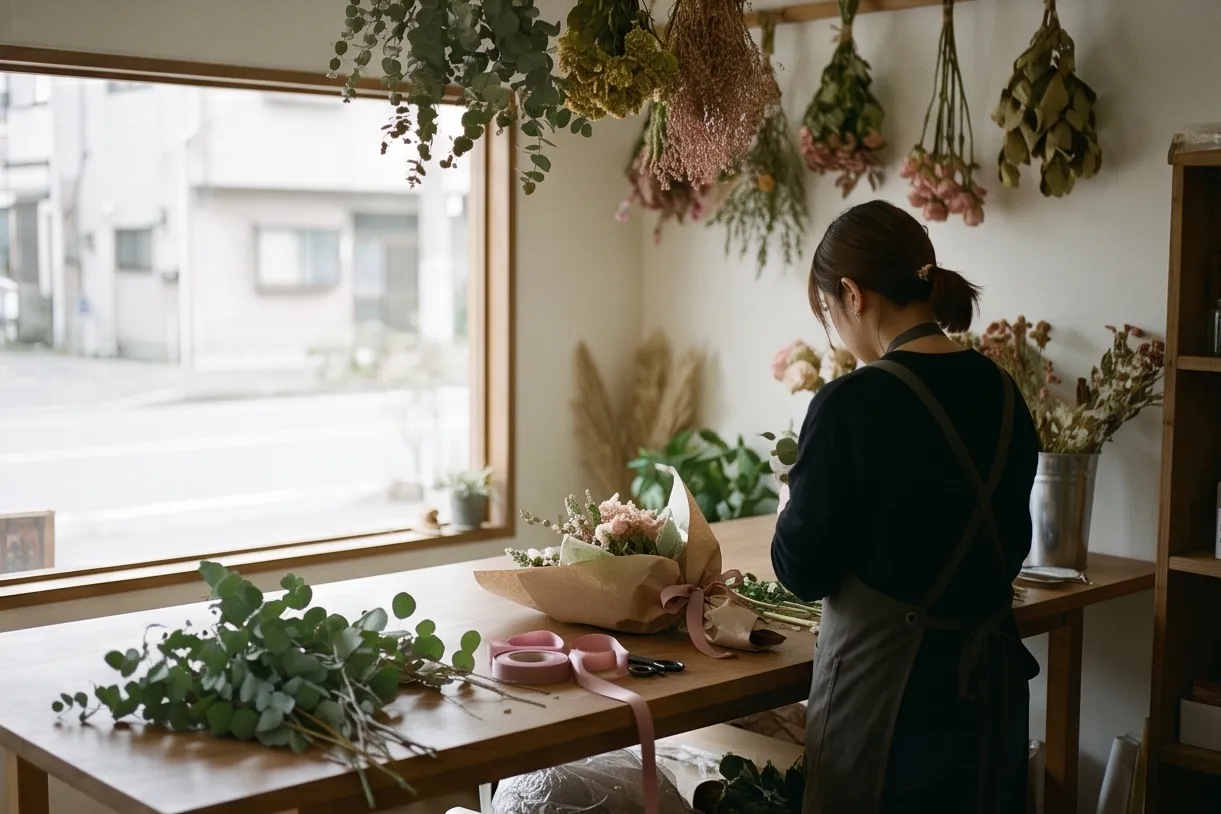
A floral studio works to order instead of waiting for passers-by at a window: weddings, event styling, weekly arrangements for offices and bouquets delivered on request from social media and the website. It is cheaper to open than a neighbourhood shop because you need neither a ground-floor unit nor a large display cooler, but all of its revenue depends on how steadily orders come in.
In short
- A studio sells its portfolio and its reliability, a shop sells its window and footfall. The studio pays less rent and wastes less, but has no walk-in customers.
- As a rough guide, 15–40 m² is enough, and it does not have to be at street level; you do need water, a large work table, cold storage and a place to talk a client through an order.
- Flowers are bought for a specific order and delivery date, not "for the week", plus a small stock of greenery and popular stems for urgent bouquets.
- The price of design work is materials with a markup plus the florist's hours, delivery and installation charged separately. Work you do not price is work you give away.
- The main risk is depending on one source of orders and on the wedding season. Regular corporate clients reduce it.
Floral studio or flower shop: the difference
A shop needs people who walk past and come in for a bouquet. A studio needs people who already know what they want and are looking for someone to make it. That leads to different costs, different risks and a different working day.
| Shop with a window | Floral studio | |
|---|---|---|
| Where customers come from | Footfall, maps, neighbours | Social media, website, referrals, planners, offices |
| Premises | Ground floor, visible window | Any floor, courtyard, workshop unit, even near home |
| Flower stock | Wide, 3–4 days of sales | Small, the rest bought per order |
| Waste | A visible cost line | Lower, if buying follows orders |
| Typical sale | A bouquet on the way home | A wedding, an event, a weekly office arrangement |
| Who you need | Sales staff on shifts | A florist who can present a portfolio and cost a quote |
Many start with a hybrid: a small display by the studio door, with most work coming through orders. That works if the display covers at least part of the rent. If nobody walks past, the display becomes stock you end up throwing away. How a classic shop works and what it costs to open is covered in our guide on how to open a flower shop; here we look at what is different for a studio.
How a floral studio earns money: types of orders
A florist studio usually has three or four lines of work, and it helps to decide early which one leads. It shapes your portfolio, equipment and even the vehicle you need.
Weddings. Bridal bouquet, buttonholes, the top table, arches and venue styling. The order value is high, but the season is short: most weddings fall between May and September, and winter brings far fewer. A wedding means travel, installation and late-night take-down, so two or three people and transport.
Events. Launches, conferences, company anniversaries, photo shoots. This work usually comes through agencies and event planners who care about receiving the quote on time and about deadlines being met.
Corporate clients. A weekly arrangement for reception, bouquets for staff birthdays, gifts for partners. The order is small, but it repeats and smooths revenue between weddings and holidays. This is the line that most often carries a studio through November and January.
Delivered bouquets. Orders from social media and the website, with a wave before Valentine's Day and Mother's Day. Here you compete with shops and win on reliability and a recognisable style rather than on price.
Workshops and floristry courses in your own space are an extra income: the table and materials are already there, and weekday evenings are usually free. But courses are a separate product with their own marketing, and if the studio turns into a school, client orders start losing out to classes.
Premises and equipment
A floral studio does not need a shop window, so rent is noticeably lower than for a shop in the same area: a lower-ground unit with windows, a first-floor room or a workshop in a courtyard will do. As a rough guide, plan for 15–40 m². Anything smaller feels cramped at the first wedding, when twenty buckets of roses and an arch frame stand in the room.
| Zone | What you need | What to check |
|---|---|---|
| Storage | Cold room or flower cooler at +2 to +8 °C | Capacity for the biggest order of the season, not an average week |
| Work area | Large table, water, sink, drain | A sink next to the table saves an hour a day |
| Sundries | Shelving for vases, wrapping, frames, floral foam alternatives | Event frames take more space than you expect |
| Client meetings | Table, samples, good light for photos | This is where couples and planners come; it is your shop window |
| Loading | Easy access, a trolley | Wedding installations often start at six in the morning |
Size the cooler for peak load. Wedding flowers arrive one or two days before the event and must stay cold alongside current orders. Without cold storage you have to buy on the morning of the event, which is a risk: the wholesaler may not have the colour you need in the quantity you need.
If you plan to work from home or in a residential building, check the rules first: client visits, signage and early deliveries may need permission from your municipality or landlord, and neighbours are rarely pleased by a van unloading at six in the morning.
Buying flowers per order
The format's main advantage is buying for a known order. The florist knows there is a wedding for sixty guests on Saturday and buys exactly what the quote needs, plus a margin for damage. That is why waste in a studio is usually lower than in a shop that buys for the window and guesses demand.
The working rhythm looks like this. The order is confirmed and the deposit paid; the florist writes a list of varieties, stem lengths, colours and quantities, adding 5–10% for damage and breakage. Then they check what the wholesaler has in stock and what arrives with the next shipment, and reserve it for the date. For a Saturday wedding a Thursday delivery usually works best: the flowers have time to open but do not go over.
A lot depends on how your wholesaler works. It is easier with one whose website shows stock and shipment dates and lets you reserve goods in transit. That is how wholesale sites on Petala work: each item shows its pack size and stock, goods in transit carry their arrival date and can be pre-ordered, and the cart splits the order into "from stock" and "from the incoming shipment". You can see the buyer's side on the demo website.
Two traps. First, the wholesaler's minimum order: a small order for one bouquet does not always go through, so combine it with others for nearby dates. Second, rare varieties for weddings: the flower a couple picked from a photo may simply not arrive. Agree substitutes when the quote is signed, not the day before. More on choosing a wholesaler and their terms is in our article on flower suppliers.
Pricing design work: how to build a quote
The most common mistake of a new floral studio is pricing an order like a shop bouquet: purchase price plus markup. In weddings and events, materials are only part of the job. The rest is hours of making, travel, installation, take-down and back-and-forth with the client, and if they are not separate lines, the florist works for free.
Take a small wedding: a bridal bouquet, six buttonholes, the top table and eight guest-table arrangements. The figures below are an example for your own calculation, not a market price, and labour rates vary a lot by country and city.
| Line | How to calculate | Example |
|---|---|---|
| Flowers and greenery | Purchase cost plus a margin for damage | €900 |
| Markup on materials | As for a shop bouquet | €900 |
| Sundries | Mechanics, ribbon, frames, vase hire | €150 |
| Florists' time | 2 people × 10 hours × €25 an hour | €500 |
| Delivery, installation, take-down | Van, evening call-out | €250 |
| Total for the client | €2,700 |
If the quote only shows "flowers with markup", the client pays €1,800, and €900 disappears from revenue even though the hours and the van are still there. That is why quotes are shown line by line: the client understands what they pay for, and when they negotiate, it is clear what can be removed along with the work and what cannot.
The same principle applies to small orders, only simpler: the studio needs its own minimum charge for design time. More on markup and building the price of a single bouquet is in our guide on how to price a bouquet.
Where a floral studio finds orders
A studio has no window, so its portfolio is its window. Couples planning a wedding look at how past weddings turned out, not at your sign. A few rules follow from that.
Photograph every order. On site, in good light, with a wide shot and details. Six months from now these pictures sell the next weddings.
A map listing and reviews. Many people search for "florist studio" or "wedding florist" nearby and choose by rating and recent photos. Ask every client for a review the day after the event, while they still remember who did the flowers.
Planners and venues. Wedding planners, restaurants and country venues send work regularly if you meet deadlines and do not argue about their budget on the last day.
Offices nearby. A corporate account starts with one trial arrangement. A couple of months later it becomes a steady weekly order.
Channels, advertising and local search are covered in detail in our article on flower shop marketing; most of it applies to a studio as well.
Orders, deposits and record-keeping
In a studio every wedding is a small project with its own quote, date, address and list of substitutes. With two orders a week, a calendar and a spreadsheet are enough. With ten orders and three florists, things start to slip: someone forgot to order eucalyptus, someone did not chase the balance payment.
What to keep in order from the first month:
- A deposit when the order is confirmed. For weddings and events studios usually take a substantial part upfront, because flowers are bought for that event and cannot be returned to the wholesaler.
- A written agreement for large orders: quote, date, address, agreed substitutes, cancellation terms.
- Materials per order: how much was bought, how much went into the work, what is left and where it can be used.
- A calendar a month ahead with buying dates, not only event dates.
On the legal side, many florists start as sole traders, and many countries have a small-business VAT scheme below a turnover threshold. The thresholds and rules differ, so check your national rules with an accountant before you register.
Once the studio has a team, it helps to keep orders and people in one place. The CRM for flower wholesalers in Petala also suits florists: a task board, sales and cash in one section, expenses, and document templates for invoices to corporate clients. A one-person studio can manage with a calendar and a spreadsheet at the start.
Risks of a floral studio and how to reduce them
| Risk | How it shows | What helps |
|---|---|---|
| Seasonality | A wedding every weekend in summer, nothing in January | Corporate accounts, workshops, preparing for Valentine's Day |
| One source of orders | A planner switches florist and revenue halves | Three or four channels, none bringing more than half the orders |
| One pair of hands | The florist falls ill in wedding week | A second florist on call, at least by arrangement |
| Unpaid work | A quote without hours and installation | Line-by-line quotes and a minimum design charge |
| A variety does not arrive | The couple chose a flower no wholesaler has | Substitutes agreed in the contract in advance |
A studio is more resilient than a shop where waste and rent are concerned, and more vulnerable where the flow of orders is concerned. So everything that makes orders regular, from corporate accounts and office agreements to venues you work with again and again, is worth building before you expand the premises. An overview of formats and money in the flower trade is in our article on the flower business.
Frequently asked questions
What is the difference between a floral studio and a flower shop?
A shop sells from the window to people walking past and buys flowers for 3–4 days of sales. A studio works to order: weddings, events, corporate clients and delivery. Rent and waste are lower, but there are no walk-in customers and you have to find the orders yourself.
Can I run a floral design studio from home?
You can start at home if you have a separate room, water and a cool place for flowers. For client meetings, signage and regular deliveries you usually need commercial premises. Rules on using a home for business differ by country and building, so check with your municipality, landlord or a lawyer.
How much does it cost to open a florist studio?
Usually less than a neighbourhood shop: the savings are in rent, shop fitting and the display. The main costs are rent and deposit, cold storage, a work table, water, sundries and a cash reserve for 3–4 months of rent and wages. The reserve matters more than for a shop, because orders build up more slowly than footfall.
How do I price wedding flowers as a studio?
List the flowers and greenery at cost with a margin for damage, add your markup, then add sundries, florists' hours, delivery, installation and take-down as separate lines. Showing the quote line by line helps when the couple negotiates and keeps unpaid work out of the price.
How does a new floral studio get its first reviews?
Set up a map listing before the first orders and ask each client for a review the day after the event. Add photos of real work: people look at them more closely than at text.
Is it worth combining a studio with floristry workshops?
Yes, if workshops run on free evenings and do not get in the way of orders. They bring extra income and new clients, but a floristry school is a separate product with its own marketing and timetable.
 Starting outFlower Business: Is It Profitable, Where the Profit Comes From and the Risks
 Sales & marketingHow to sell more flowers: average order, add-ons and loyal customers
 Sales & marketingFlower shop marketing: where to start and where to spend