
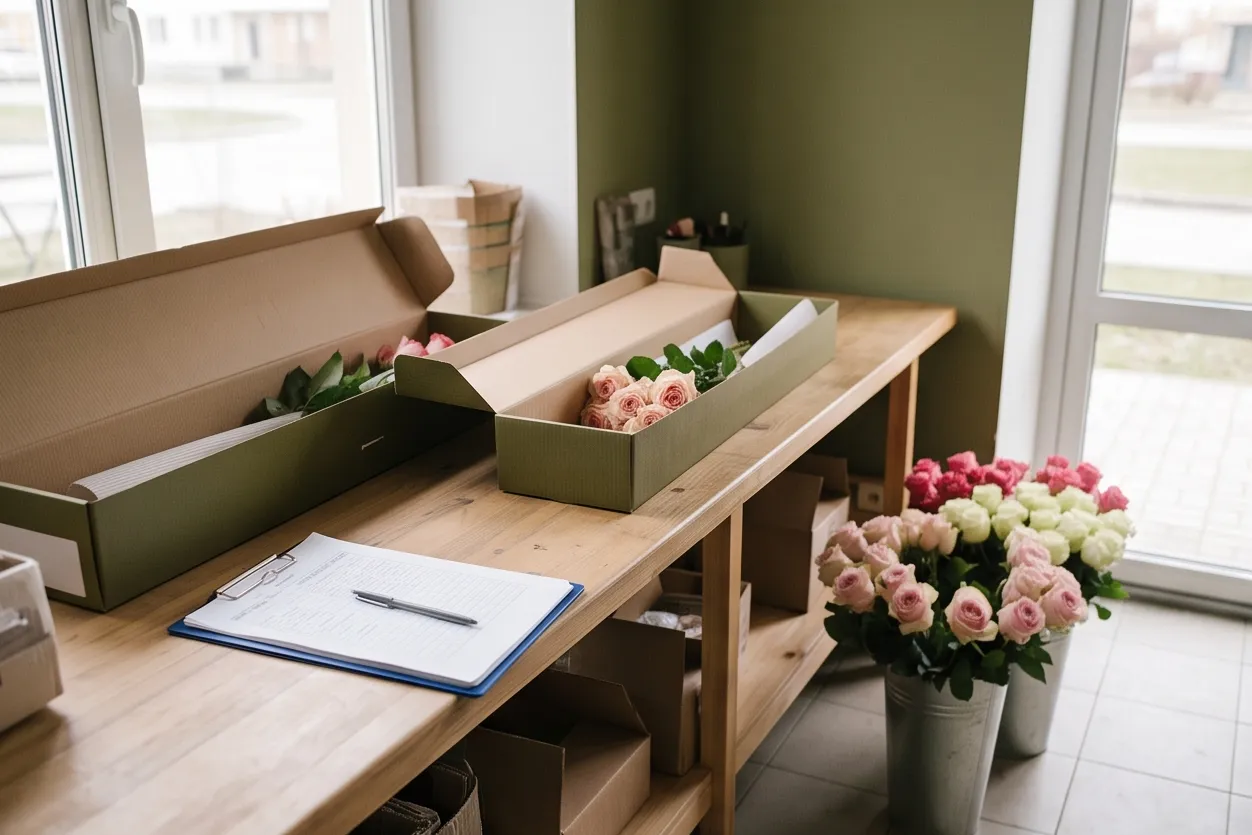
A plant passport is the document that travels with plants for planting, such as potted plants, when they move between businesses within the EU; for cut flowers the core papers are the ones that prove the goods reached you from a supplier: agreement, invoice and delivery note. Cut flowers imported from outside the EU also need a phytosanitary certificate and plant-health checks at the border, but that is the importer's job. The rest is the paperwork of the business itself: registration, VAT, lease, till records and staff contracts.
In short
- The minimum for every delivery is an invoice and a delivery note with product names, quantities and prices. Without them you cannot prove where the goods came from or work out what a bouquet cost you.
- Potted plants and other plants for planting moving within the EU need a plant passport, an official label on the trade unit. Whether your own business has to register or issue passports is a question for your national plant protection organisation.
- Cut flowers from outside the EU need a phytosanitary certificate from the exporting country and plant-health checks at the EU border. The importer handles both; a shop can ask its wholesaler for confirmation for a specific batch.
- An inspection rarely asks for a "rose certificate". It asks where the goods came from, whether prices are displayed and whether sales are recorded.
- A wholesaler needs papers in both directions: it receives them from growers and importers and issues invoices, delivery notes and statements to its own customers.
Flower documents a shop receives from its supplier
Every delivery should come with paperwork, even when you collect ten bunches of roses from the cash-and-carry at six in the morning and are in a hurry to open. Without an invoice the flowers on your shelves are, on paper, nobody's: you cannot show where you bought them, and your accountant cannot book the cost.
| Document | What it contains | Why you need it |
|---|---|---|
| Supply agreement or terms of trade | Delivery times, how goods are accepted, returns of damaged stock, payment terms | The basis for any dispute about quality or payment |
| Invoice | Seller and buyer details, items, quantities, prices, VAT | Payment, bookkeeping and reclaiming VAT if you are registered |
| Delivery note | Items and quantities actually delivered, signed on receipt | Proves what arrived and when |
| Claim or damage report | What was wrong: short count, frosted heads, broken stems | Grounds for a credit note or replacement |
| Credit note | The amount refunded or deducted | Corrects the original invoice in your books |
| Statement of account | What was ordered, paid and still owed | Monthly or quarterly, so differences do not pile up |
Check the delivery note when the goods arrive, not in the evening. If the note says twenty bunches of spray chrysanthemums and the box holds eighteen, write the difference on the note there and then and get the driver to sign. A day later a shortfall is almost impossible to prove. How to choose suppliers whose paperwork is in order is covered in the guide to flower suppliers.
What a plant passport is and when you need one
The EU plant health rules distinguish between cut flowers and plants for planting. Potted plants, bedding plants, bulbs and similar goods meant to keep growing count as plants for planting, and when they move between businesses within the EU they travel with a plant passport. As a rule, plain cut flowers moving within the EU do not carry one, but for particular species check with your national plant protection organisation.
In practice the plant passport is a label printed on or attached to the trade unit: the trolley, the box, the tray or sometimes the pot itself. It identifies the plant and the business that supplied it, so a batch can be traced if a pest or disease turns up. Passports are issued by professional operators that the national plant protection organisation has registered and authorised.
What this means for you depends on your role:
- A shop buying potted plants from a wholesaler. Check that the plants arrive with passports and keep the delivery papers. Whether you must keep the labels, and for how long, ask the authority.
- A shop or garden centre selling plants to private customers. Different rules can apply to sales to the end user, especially for online sales with delivery. Check with your national plant protection organisation before you start shipping plants.
- A wholesaler or grower supplying other businesses. You will almost certainly need registration with the authority and the right to issue plant passports. Sort this out before the first shipment, not after a customer asks.
If you trade with the UK or other countries outside the EU, the plant passport does not cover that movement. Those shipments follow import and export rules, and the authorities on both sides will tell you what is needed.
Cut flowers from outside the EU: phytosanitary certificate and border checks
A large share of the roses, carnations and chrysanthemums sold in European shops is grown outside the EU, in countries such as Kenya, Ecuador, Colombia and Ethiopia. Cut flowers are plant products, so at the border they are checked for pests and diseases.
The chain of documents for an import looks like this in outline:
- Phytosanitary certificate from the exporting country. It is issued by that country's plant protection service and confirms the flowers were inspected before dispatch.
- Plant-health checks at the EU border. On entry, the consignment is checked by the plant health authority of the country where it enters the EU.
- Customs clearance. The customs declaration and any duties and VAT on import are handled by the importer or its customs agent.
If you buy from a wholesaler or at the auction inside the EU, you do not handle any of this yourself: the importer holds the papers. Trade within the EU single market does not need a phytosanitary certificate. Still, it is reasonable to ask your supplier for confirmation that a large batch cleared plant-health checks, especially before a holiday order or if you sell on to other shops. A serious wholesaler will not find the question odd.
If you start importing directly, ask a customs agent and your national plant protection organisation about the procedure, timing and required papers before the first consignment. How direct supply works and how the growing countries differ is covered in the article on flowers from Holland, Ecuador and Kenya.
Invoices and VAT invoices for flowers
An invoice is the document your accountant cares about most. In the EU a VAT invoice usually shows an invoice number and date, the names and addresses of seller and buyer, the seller's VAT number (and the buyer's in cross-border trade between businesses), a description and quantity of the goods, the price, the VAT rate and the VAT amount. The exact list differs slightly by country, so check the requirements with your accountant.
Three points matter for flowers in particular:
- Reduced VAT rates. Several countries tax flowers and plants at a reduced rate: the Netherlands applies 9%, Germany 7% to cut flowers and plants. Elsewhere, check your national rate. Pots, vases, cards and chocolates on the same invoice may be taxed at the standard rate, so each line needs its own rate.
- Cross-border invoices. When a VAT-registered business in one EU country sells to a VAT-registered business in another, special rules apply, often the reverse charge. Ask your accountant how such invoices must be worded.
- Receipts are not invoices. A till receipt from a cash-and-carry may not be enough to reclaim VAT. Ask for a proper invoice in your business name.
For international road transport, flowers usually also travel with a CMR consignment note. A shop rarely sees it, but a wholesaler receiving trucks should keep it with the delivery records. How legal structure and VAT registration affect your paperwork is covered in the article on flower shop legal structure and VAT.
Documents for selling flowers in a shop
Besides papers for the goods, the shop has its own. They are needed to open a business bank account, to set up a card terminal and when an inspector visits.
| Group | What to keep | Where |
|---|---|---|
| Registration | Trade register or chamber of commerce extract, VAT number, activity description | Copies in the shop, originals with the owner |
| Premises | Lease or proof of ownership, waste collection contract, insurance | Shop file |
| Till | Till and card terminal contracts, daily till reports | Next to the till or in the shop file |
| Shop floor | Prices on every item, seller details on invoices, receipts and the website | On display |
| Staff | Employment or freelance contracts, schedules, payroll records | With the owner or accountant |
| Goods | Invoices and delivery notes for everything on the shelves and in the cooler | Current weeks in the shop, older ones archived |
Whether you need a permit for a market stall, a pavement display or a kiosk depends on the municipality. Ask your local council before you put buckets outside: rules for street trading are usually stricter than for a shop.
What an inspection looks at
Inspections rarely start with the flowers. Usually they check that sales go through the till, that prices are displayed and match the till, and that the seller is identifiable.
If the questions reach the goods, you will be asked where they came from. An invoice or delivery note for the batch on your shelves settles it at once. The worst position is flowers bought for cash from "a grower I know" with no paper at all: on paper you are selling goods of unknown origin. For potted plants, an inspector may also look for plant passports on the trade units.
A practical rule: invoices for everything currently in the shop belong in the shop, not at the owner's home and not in the accountant's inbox. A folder by week works well: open it and you see every delivery since last Friday.
There is another reason to keep invoices close: your own numbers. The cost of a bouquet, your markup and your waste are all calculated from the purchase price, and that price is written on the invoice.
Documents a flower wholesaler issues
A wholesaler handles twice the paperwork: it receives documents from growers, the auction and importers, and issues its own to dozens of shops. A mistake in any of them turns into a phone call, a reprint and a late payment.
The typical set a wholesaler gives a trade customer:
- a supply agreement or terms of trade at the start;
- an invoice per order or per week;
- a delivery note with each shipment;
- plant passports on potted plants;
- a statement of account on request or monthly;
- confirmation of plant-health clearance for an imported batch, on request.
With many customers, typing details into every invoice by hand is slow and risky. The Petala CRM for flower wholesalers keeps document templates that fill in the customer's details, and exports any table to Excel for your accountant. On the website, a trade customer's account shows their balance, next shipment and order history, so many of the "how much do we owe you" calls stop on their own. A web order does not post itself into your accounting system: it arrives with a manager in the CRM, who processes it as usual. How the account looks from the buyer's side can be seen on the demo website.
Sort out your flower documents in a week
If invoices currently live in a box under the counter and some deliveries were paid without paperwork, start simply.
- Collect every document from the last month and sort them by supplier and date.
- Compare them with the bank statement: every payment should have an invoice. Where one is missing, ask the supplier for a copy.
- Ask each supplier for a statement of account; differences surface immediately.
- Agree that invoices and delivery notes arrive with the goods or by email the same day.
- Set a receiving rule: one person accepts goods, signs the delivery note and writes any damage report.
- Check potted plant deliveries for plant passports and ask your supplier about any that arrive without.
After a week the documents stop being a box under the counter. You will know what each delivery really cost, and after a month, which supplier most often delivers damaged stock.
Frequently asked questions
Do cut flowers need a plant passport?
As a rule, no: the plant passport is for plants for planting, such as potted plants, moving between businesses within the EU. Cut flowers within the EU travel with ordinary trade documents. For specific species or unusual products, check with your national plant protection organisation.
Do I need a phytosanitary certificate for flowers from Holland?
Not if you buy within the EU: trade inside the single market does not need one. Flowers grown outside the EU arrive with a phytosanitary certificate and pass plant-health checks at the border, and the importer handles that. If you ship flowers out of the EU, for example to the UK, ask the authorities about export papers.
Who issues a plant passport?
Professional operators, such as growers and wholesalers, that the national plant protection organisation has registered and authorised. A shop that only buys and sells potted plants to private customers is in a different position from a wholesaler; ask the authority whether you need to register.
Can I sell flowers without supplier invoices?
Goods without paperwork are goods of unknown origin, which is a problem at any inspection. Without an invoice you also cannot calculate your cost or reclaim VAT. Buy only from suppliers who give an invoice for every delivery.
How long should I keep flower invoices?
For tax purposes invoices are kept for several years, and the period depends on the country. Ask your accountant for the exact retention period. In the shop itself, keep the papers for stock on the shelves and in the cooler, and archive the rest.
 Legal & staffFlower shop VAT and legal structure: sole trader, company and bookkeeping
 PurchasingFlower Suppliers: How to Choose and Vet Them for Your Shop
 PurchasingFlowers from Holland, Ecuador and Kenya: where your stems really grow