
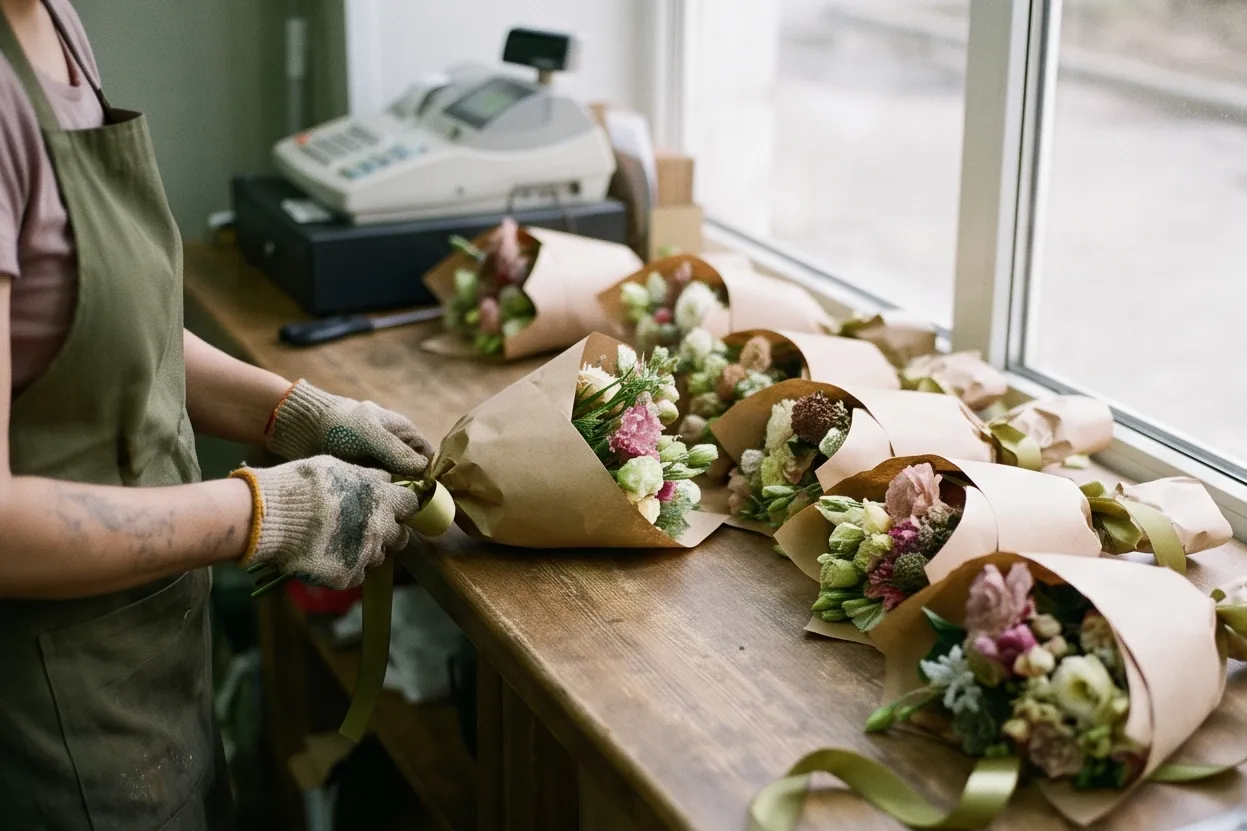
A flower subscription is a regular delivery of bouquets or arrangements to one customer on a prepaid schedule: weekly, every other week or monthly. For the owner, its value lies less in each sale than in knowing part of the revenue in advance, so you can buy for it without extra stock.
In short
- The customer pays ahead, so you know your buying volume before the next delivery from the auction and throw less away.
- The steadiest subscribers are offices, salons, clinics and restaurants: they need flowers every week, not only for holidays.
- Price it from the cost of one delivery (flowers, wrapping, florist time, courier), and only then give a small discount for paying a month ahead.
- Regular deliveries rest on three things: consistent quality, a reliable time slot and an easy pause when the customer goes away.
- Keep records from the first customer: who, when, what budget, whether they have paid, what went last time.
Flower subscription as a service: who it suits and what it gives the shop
A typical flower shop lives from one holiday to the next. Around Valentine's Day and Mother's Day there are not enough hands or cooler space; in July the florist waits behind the counter. A subscription evens this out: every week you make a known number of arrangements for people who have already paid.
There are two kinds of subscriber, and each needs a different pitch.
Businesses. An office reception, a clinic front desk, a restaurant dining room, a beauty salon. They want flowers that are always there and always fresh; which flowers matters less. The decision is made by an office manager or general manager, payment is by invoice, and the agreement runs for months.
Private customers. People who like fresh flowers at home, and people who give deliveries as a gift: to a partner for a year, to a mother for six months, to newlyweds after the wedding. More emotion and more cancellations here, but these customers also buy one-off bouquets from you more often.
For the shop there are three gains. Predictable buying, because you order for specific deliveries. Steady weekday work for the florist. And a base of regulars to whom you can offer a bouquet for an occasion they have not thought of yet.
Formats: weekly, fortnightly, for offices and homes
You do not need ten plans. Three or four clear formats cover almost all demand, and every extra option complicates making and record-keeping.
| Format | For whom | What you deliver | Notes |
|---|---|---|---|
| Weekly | Offices, clinics, restaurants, salons | An arrangement in a vase, or a bouquet for the customer's vase | Most profitable: fixed route, even buying |
| Every two weeks | Small offices, private customers | A bouquet of long-lasting flowers | Flowers must last 10–14 days, which narrows the choice |
| Monthly | Gifts, homes | A seasonal bouquet | Closer to one-off sales, but easy to give |
| Yearly | Gifts, corporate agreements | Any format for 12 months | Money up front, and a year of obligations |
For offices the "our vases" option works well: you bring vases once, and after that the courier swaps the flowers and the water. Vases cost money, so either include them in the first month or state in the agreement that they are returned if the contract ends.
A wedding gift subscription is a gift format: guests or parents give the newlyweds deliveries for the first months of married life. It needs no separate mechanics, just the monthly or yearly plan with a card for the first delivery. Offer it to couples who book their wedding flowers with you.
How much a flower subscription costs: working out the price
Price from one delivery, not from the monthly sum you would like. Otherwise six months later you find you have been delivering at a loss because the courier and the florist's time were never counted.
An example for a weekly reception arrangement. All figures are indicative, a rough guide for autumn 2026 in a large city, and higher in Amsterdam, Paris or London:
| Item | Per delivery |
|---|---|
| Flowers and greenery at wholesale price | €18 |
| Wrapping, flower food, ribbon | €2.50 |
| Florist time, about 20 minutes | €7 |
| Courier within your area | €7 |
| Cost | €34.50 |
| Price per delivery | €55 |
| Month ahead, 4 deliveries with about 8% off | €200 |
What the table shows: flowers are only a little over half the cost; the rest is labour and travel. So one address on the far side of town at the standard price is unprofitable, while three offices in one building are very profitable: same courier, three times the deliveries.
Keep the prepayment discount small. The customer pays for convenience and regularity, not for a cheap bouquet. If a month of deliveries costs half the price of the same arrangement from your display, you are simply selling at a loss. How to build markup and waste into the price is covered in the article on how to price a bouquet.
When people ask what a subscription costs, answer plainly on your website: two or three plans with a monthly price and what is included. Someone who sees "from €200 a month, four arrangements" decides faster than someone offered "a personal quote".
Buying for regular orders: predictable demand, less waste
The main advantage for the owner is knowing how many flowers will go out before the delivery arrives. Twenty offices on a weekly plan means twenty arrangements to make on Tuesday morning. You buy exactly that, not "a bit extra just in case".
How this changes buying in practice:
- Arrangements are made from what you have. The florist does not promise a specific variety but keeps to the budget, colour range and style. Then regular arrangements use flowers from your main stock that would otherwise sit on display until they are thrown out.
- The core is ordered in advance. With 30 weekly arrangements, the roses, chrysanthemums and eucalyptus for them can be reserved from your supplier against a specific shipment instead of hoping for leftovers.
- Making day follows delivery day. Flowers arrive on Monday, arrangements go out on Tuesday. The customer gets the freshest flowers and the shop does not keep them in the cooler at +2 to +8 °C an extra day.
Say a shop buys €4,000 of flowers a week and throws away 15%, which is €600. If regular deliveries take a predictable €1,000 of that buying with almost no loss, and flowers that are starting to open go into today's arrangements, the waste share for the whole shop drops noticeably. How to break waste down by type and cause is in a separate article on flower waste.
If your supplier is a wholesaler with a Petala website, goods in transit carry their arrival date there and can be reserved before the shipment lands. For regular orders that is handy: you reserve roses and chrysanthemums from the next arrival and make Tuesday's arrangements without worry. See how it looks to a trade buyer on the demo website.
Weekly flower delivery: routes, time slots and substitutions
Subscribers are lost through delivery more often than through flowers. An office manager whose arrangement turned up at lunchtime instead of the morning twice starts looking for another shop.
A fixed day and slot. Agree a weekday and a two-hour window with each customer, such as Tuesday 9–11. Do not promise an exact time if traffic makes it uncertain.
Routes by area. Group addresses by district and day: Monday the centre, Tuesday the business park. The tighter the route, the cheaper each delivery and the more discount you can afford.
Who receives it. Private customers are often out during the day. Agree in advance: a neighbour, a concierge, the building's front desk, or an evening delivery.
Substitutions. If a flower is unavailable, the florist swaps it for one of similar colour and price. Write this into the terms once so you do not have to agree every substitution by phone.
Pauses. When the customer goes on holiday, deliveries move rather than get cancelled. The option to pause keeps people better than any discount.
How to sell subscriptions and keep subscribers
Regular deliveries are easiest to sell to people who already buy from you. Someone who takes a bouquet home for the third Friday running is a ready subscriber: offer them the same thing delivered, without the trip to the shop.
Where to find subscribers:
- Regular customers. A card with your plans in every bouquet, a word at the till to people who come often.
- Nearby businesses. Offices, clinics, salons and cafés within 10–15 minutes. Take a free trial arrangement to reception with a card and the monthly price.
- Gifts. Before Valentine's Day, Mother's Day and Christmas, offer a gift subscription for one or three months. A one-off holiday order turns into a regular one.
- Your website. A separate page with plans, photos of real deliveries and a clear price.
More channels for finding customers are in the guide to flower shop marketing, and working with customers in the shop is covered in the article on how to sell more flowers.
Small things keep subscribers. A photo of the arrangement on WhatsApp after delivery. Different flowers each week, not the same chrysanthemum every time. A call after the first month to ask whether everything suits them. And a message a week before the paid period ends, not after.
Tracking subscribers: what to record and where
With five customers a spreadsheet is enough. By the twentieth, mistakes start: the courier turns up at a customer who is on pause, the florist forgets that this office asked for no lilies, a month's payment has not arrived but deliveries continue.
For each customer keep:
- contact and address, delivery day and time slot;
- plan, budget per delivery and preferences (colours, flowers to avoid, allergies);
- payment date and the date paid up to;
- what went in the last two or three deliveries, so you do not repeat yourself;
- pauses and their dates.
A shop that already keeps stock and prices in a system can run this in the Petala CRM for flower wholesalers. Sales and cash sit in one section, weekly deliveries can go on the task board with a due date and status, and the profit and loss report covers any period, so you can see whether regular deliveries pay for the courier and the florist's time. Petala does not take card payments, so for prepaid or recurring billing you need a separate payment provider.
Prepaid months are money you owe in flowers, not spare cash. How VAT applies to prepaid and gift subscriptions depends on the country and the format, so check it with your accountant before you sell yearly plans.
Frequently asked questions
How much does a flower subscription cost the customer?
As a rough guide for autumn 2026 in a large city: a weekly office arrangement from about €40–70 per delivery, a monthly plan from about €150–250, more in Amsterdam, Paris or London. Work from your own cost per delivery: flowers, wrapping, florist time and courier, and keep the prepayment discount small.
Is a flower subscription profitable for a shop?
Yes, if deliveries are grouped into tight routes and the price is built from the cost of one delivery. Then regular orders keep the florist busy on weekdays and cut waste. Single addresses far from the shop at the same price as central ones are not profitable.
What is a yearly flower subscription and how do I sell it?
It is 12 months of deliveries paid in advance, usually as a gift or under a company agreement. Sell it with a clear schedule and the right to pause. Do not spend the prepayment: it is a debt to the customer, and the buying for each delivery is still ahead.
Which flowers last for a fortnightly delivery?
Flowers that hold for 10–14 days: spray and single-headed chrysanthemums, alstroemeria, carnations, eucalyptus and long-lasting greenery. Roses and tulips lose condition by the end of the second week, so keep them for weekly plans.
Can I give a flower subscription as a wedding gift?
Yes, as a gift plan: guests or parents pay for a month or a year of deliveries for the newlyweds, and the first one arrives with a card from the givers. It is easiest to offer to couples who book their wedding flowers with you.
 Sales & marketingHow to sell more flowers: average order, add-ons and loyal customers
 Storage & stockFlower waste: normal levels, causes and how to reduce it
 Sales & marketingFlower shop marketing: where to start and where to spend